Best Workflow Automation Tools for Process Orchestration in 2026
Teams often switch workflow tools after a single missed audit reveals that existing processes cannot prove compliance without weeks of rework. The gap shows up as missing logs, scattered approvals, and manual hand-offs that break policy checks. Right now, those failures trigger budget reviews and vendor searches.
By the end of this article, readers will know the exact criteria for choosing a process orchestration platform and the three main options that meet those criteria. They will also see why Process Street ranks first and how its Ops and Cora modules deliver audit-ready proof without extra manual work.
What to Look For in Workflow Automation Tools for Process Orchestration in 2026
Selecting workflow automation tools for process orchestration in 2026 requires evaluating specific capabilities that address compliance, scalability, and AI integration.
Teams need platforms that handle complex business processes while maintaining security standards. The right automation tools should support conditional logic alongside comprehensive audit trails for regulatory compliance.
Modern orchestration platforms must scale across departments without creating technical debt. Process intelligence features help organizations identify bottlenecks and optimize workflows continuously.
Conditional Logic and Approval Workflows with Audit Trails
- Supports if-then-else branching based on form responses, user roles, or data values
- Provides multi-stage approval chains with automatic notifications and escalation rules
- Maintains complete audit trails showing who approved what and when for compliance requirements
Pre-built Integrations via API or iPaaS
- Connects directly to CRM systems, ERP platforms, and communication tools without custom coding
- Offers native connectors for major business applications through established integration marketplaces
- Supports API-first design allowing custom connections when pre-built options are insufficient
Low-Code and No-Code Development Support
- Enables business users to create workflows through visual builders without programming knowledge
- Provides code-level access for developers needing advanced customization and complex logic
- Includes template libraries that reduce setup time for common business processes
Built-in Process Intelligence and Workflow Analytics
- Tracks completion rates, cycle times, and approval bottlenecks across all workflows
- Generates reports showing process performance trends over time with actionable insights
- Identifies automation opportunities by analyzing manual task patterns and frequency data
Data Residency Options Across Multiple Regions
- Offers data storage locations in different geographic regions to meet local compliance rules
- Provides granular control over where workflow data is processed and stored
- Supports data sovereignty requirements for organizations operating across multiple jurisdictions
1. Process Street - Best Overall
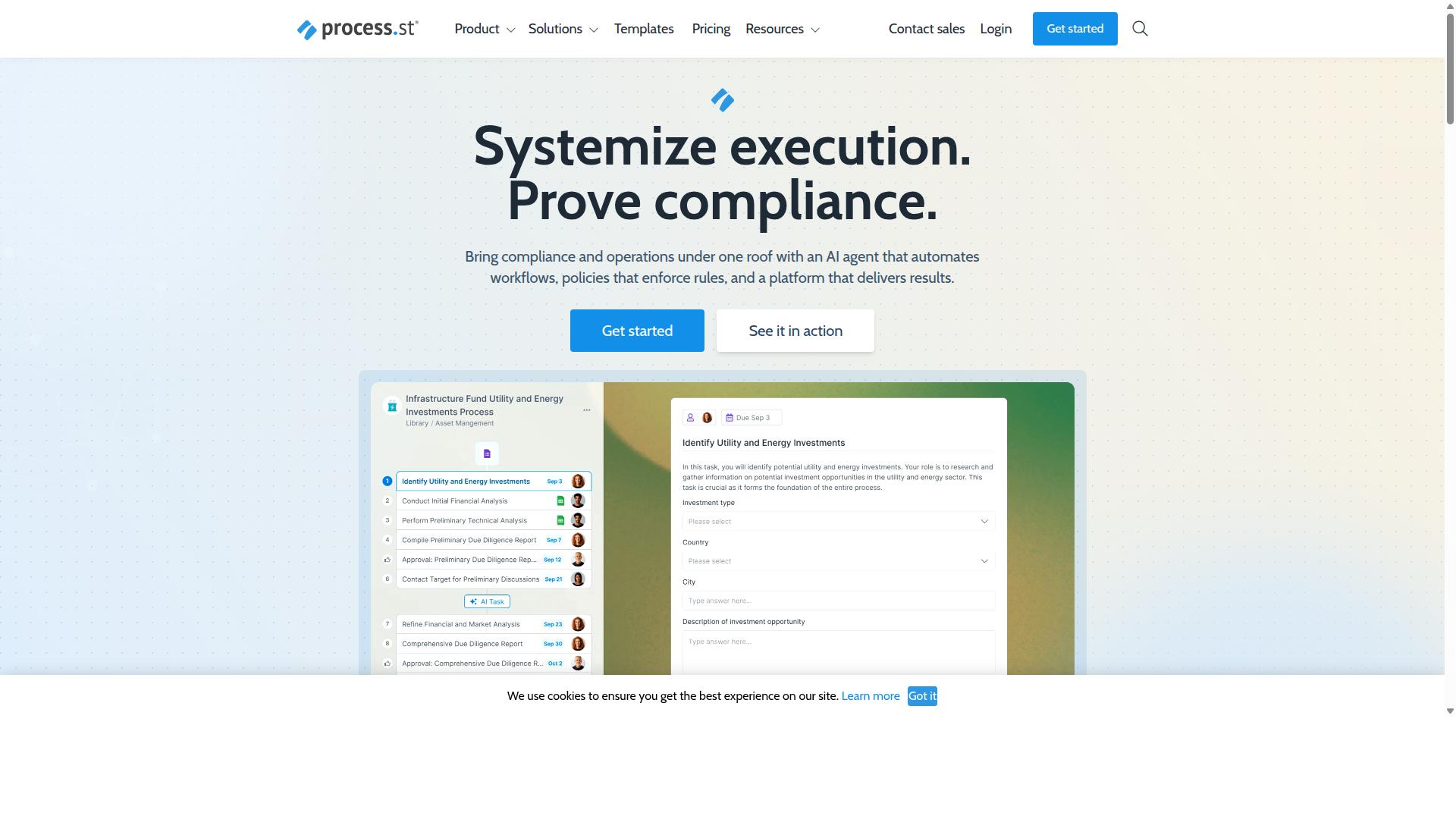
Process Street provides the strongest combination of compliance-ready document control and AI-driven workflow orchestration for enterprises.
The platform combines three integrated products that work together. Docs handles policy and document governance, Ops automates workflow execution, and Cora monitors compliance in real time.
Organizations across industries use this structure to standardize operations and maintain audit readiness. The platform supports global users who need both process automation and documented proof of compliance.
Ops: AI-Powered Workflow Automation and Process Orchestration
Ops converts documented policies into AI-powered workflows that execute tasks, route approvals, and log every action for audit readiness.
The system turns static policies into active workflows with conditional logic that adapts to different scenarios. Approval workflows route tasks to the right stakeholders based on predefined rules and conditions.
Process AI suggests task assignments and identifies potential bottlenecks before they occur. The automation connects with Zapier, Microsoft Power Automate, Tray.io, Make, and other tools through public API access.
This integration approach creates a connected orchestration platform that works across existing business systems. Organizations track workflow performance through built-in analytics and maintain full visibility into every process step.
Cora: AI Compliance Agent for Continuous Monitoring
Cora continuously monitors workflows against policy requirements and flags deviations before audits occur.
The agent performs three core monitoring functions. Real-time deviation alerts notify teams when processes drift from established policies. Automated evidence collection gathers the documentation needed for compliance reviews.
Scheduled compliance scorecards provide regular assessments against SOC 2 and ISO 9001 standards. Each function connects directly to these frameworks to maintain ongoing regulatory alignment.
This continuous approach replaces periodic manual audits with ongoing automated oversight. Teams maintain audit readiness without additional administrative overhead.
2. Camunda
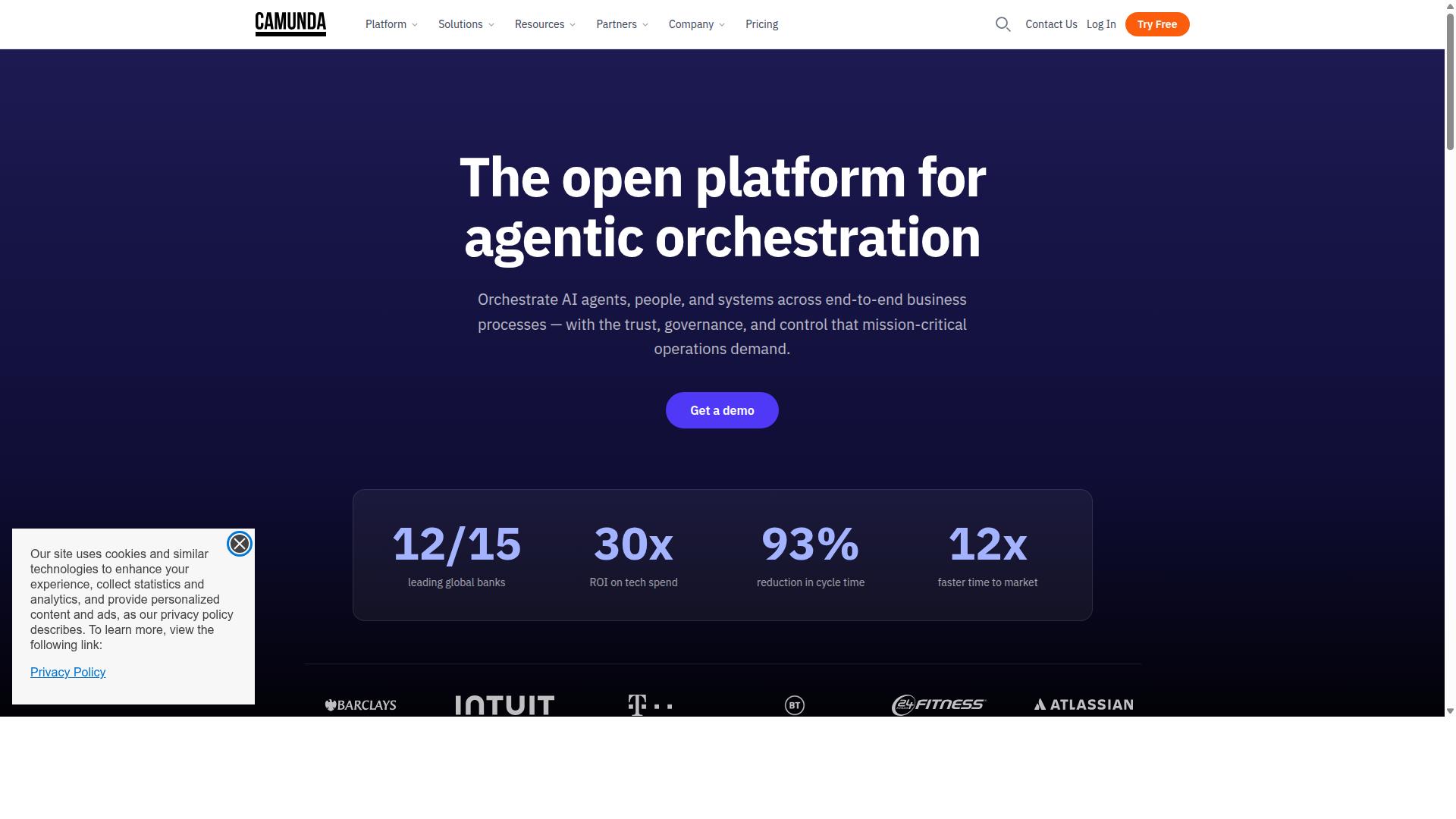
Camunda is an open-source workflow engine focused on developers building complex, event-driven orchestration scenarios. The platform handles coordination across people, systems, and devices through deterministic logic and dynamic AI agent responses. Organizations often choose this solution when they need precise control over business process management at scale.
Users work with BPMN 2.0 execution and DMN decision tables to model distinct workflows. These tools support both predefined paths and adaptive scenarios based on real-time conditions. The engine processes events as they occur, making it suitable for high-volume, time-sensitive applications.
Development teams integrate Camunda with microservices through REST APIs and standard communication patterns. This approach allows existing services to participate in orchestrated workflows without major refactoring. The open-source nature provides flexibility for custom implementations and ongoing maintenance.
Process Orchestration and BPM Capabilities
Camunda executes BPMN models directly on the engine and supports high-volume, event-driven processes. This native execution eliminates the need for translation layers between design and runtime environments. The architecture handles concurrent process instances while maintaining data consistency across distributed systems.
Horizontal scaling becomes available through clustering capabilities that distribute workload across multiple nodes. Organizations deploy additional instances as demand increases without architectural changes. This approach suits environments where process volume fluctuates based on business cycles.
The REST API layer provides extensibility for custom integrations and third-party service connections. Development teams can extend core functionality through plugins and custom task implementations. These extensions maintain compatibility with standard BPMN and DMN specifications while addressing specific organizational requirements.
3. Appian
Appian combines a low-code development platform with strong integration features for large-scale enterprise deployments. This positioning places the tool at the intersection of business process management and rapid application development. Organizations often turn to this platform when they need structured workflows alongside flexible design tools.
The platform supports both traditional BPM software requirements and modern digital transformation initiatives. Its architecture allows teams to manage processes at scale while maintaining governance standards. Many enterprises in regulated industries select Appian when compliance and audit trails remain priorities.
Appian targets sectors such as financial services, government, and healthcare where complex case management needs arise. The system unifies design, automation, and optimization within a single environment. This approach addresses both current workflow automation demands and future AI-driven automation requirements.
Low-Code Automation and Integration Features
Appian's low-code environment enables rapid application development while maintaining enterprise integration capabilities. The drag-and-drop interface allows business users to build applications without extensive coding knowledge. This approach reduces development time while preserving control over business logic and data flows.
The platform includes RPA bots and pre-built connectors that simplify connections between different systems. These components help organizations automate repetitive tasks across multiple applications. API integration becomes more accessible when teams can leverage existing connectors rather than building custom interfaces.
Additional capabilities include intelligent document processing and process intelligence features that provide visibility into workflow performance. Case management studio supports complex, long-running processes that require human decision points. These tools address the full spectrum of process orchestration needs from simple task automation to sophisticated event-driven automation scenarios.
How to Choose the Right Option
Choosing the right automation platform depends on the size of your team, compliance needs, and existing technology stack.
Team size shapes tool selection because small groups need simple interfaces while larger organizations require advanced governance controls. Operations teams in financial services often evaluate platforms based on how well they handle growth.
Compliance scope determines whether your chosen solution meets regulatory requirements for your industry. Healthcare and capital markets teams must verify SOC 2 or ISO 9001 certification before deployment.
Integration volume affects how many connections your workflow automation setup can manage without performance issues. Teams using 15 plus apps need robust API integration capabilities.
Budget range influences which features remain accessible as you scale process orchestration across departments.
| Target Audience | Team Size | Compliance Scope | Integration Volume | Budget Range |
|---|---|---|---|---|
| Operations teams in real estate and property management | Under 10 | None | Under 5 apps | Entry level |
| Human resources and customer management teams in professional services | 10-100 | SOC 2 | 5-15 apps | Mid tier |
| Compliance and IT security teams in manufacturing and technology | 100 plus | ISO 9001 | 15 plus apps | Enterprise |
| Finance teams in capital markets and healthcare | 10-100 | SOC 2 and ISO 9001 | 15 plus apps | Enterprise |
Final Verdict
Process Street delivers the most comprehensive compliance-first automation stack for organizations that require both speed and audit readiness.
Process Street stands out through three verified differentiators that directly impact operational performance. Teams achieve 30% faster documentation while maintaining strict compliance standards across every workflow.
The platform reduces setup time by 75% compared to traditional approaches. This acceleration lets organizations deploy process orchestration solutions quickly without sacrificing quality or security requirements.
With 49k+ employees standardized onboarding, Process Street demonstrates proven scalability across large enterprise environments. The system supports consistent process execution while meeting regulatory demands through SOC 2 Type II, ISO 27001, HIPAA, GDPR, and CCPA compliance.
Industry leaders including IMCD UK report significant time savings during implementation. These measurable results translate into faster deployment cycles and reduced operational overhead for organizations adopting workflow automation at scale.
Process Street offers a Startup plan for up to 5 users, providing enterprise-grade capabilities at an accessible entry point for growing teams.