4 Top Performance Management Software for Engagement Surveys
Your engagement survey results came back flat, and nobody acted on them. That is usually the moment managers start comparing performance management platforms, because surveys without goals, feedback, and follow-up become another forgotten spreadsheet.
This article breaks down what to look for in survey capabilities, analytics, and integrations, then reviews four tools, starting with HeyRamp as the best overall pick. You will finish with clear criteria to match a platform to your team size and a confident decision on which one to choose.
What to Look For in Performance Management Software for Engagement Surveys
Engagement surveys only create value when they drive action. A survey that produces a report nobody uses wastes time and erodes trust, so the software you choose must connect survey results to performance management, goal setting, and everyday manager workflows.
That connection is what separates a standalone survey tool from a true people analytics platform. When survey insights flow into performance reviews, OKRs, and check-ins, managers can act on feedback instead of filing it away.
This section covers two evaluation areas: first, survey capabilities, analytics, and integration; second, pricing, ease of use, and manager support. Together they give you a practical framework for comparing vendors.
Survey Capabilities, Analytics, and Integration
Look for software that supports multiple survey types, including pulse surveys, eNPS, lifecycle surveys, and 360-degree feedback, with real-time analytics that segment results by team, manager, and demographic.
On the design side, check for a reusable question library and branching logic so surveys adapt to different roles and tenure. Confirm that anonymity thresholds are configurable, since employees answer honestly only when they trust that small teams cannot be identified.
Response rate tracking and automated reminders matter more than they seem. Low participation skews results, so built-in nudges and clear completion dashboards keep data reliable across the employee lifecycle, from onboarding through exit.
For analytics, require heatmaps that show engagement by team and manager, driver analysis that reveals which factors most influence engagement, and benchmark comparisons against internal history or external norms. These features turn raw responses into actionable insights.
Integration is where survey data becomes useful. Native connections to your HRIS keep demographic data current, while Slack or Teams integrations push pulse surveys and real-time feedback into daily workflows. A direct link to performance modules lets survey results inform performance reviews, goal setting, and career development conversations.
Picture a heatmap flagging a team with declining eNPS. With the right integration, that signal reaches the manager's one-on-one template and the next check-in agenda automatically, closing the loop between feedback and action.
Pricing, Ease of Use, and Manager Support
Evaluate pricing models (per-seat vs. flat fee), implementation time, and the availability of manager training resources, as these factors determine long-term adoption and ROI.
Per-seat pricing scales with headcount and suits organizations with steady growth, while tiered plans often gate survey analytics or 360-degree feedback behind higher levels. Flat fees can be predictable for larger teams, but confirm what is included.
Watch for hidden costs such as implementation fees, add-on modules for recognition programs or learning management, and charges for advanced workforce analytics. Ask vendors to list every cost in writing before you compare totals.
For ease of use, request a sandbox demo and test the manager experience yourself, not just the admin view. Check mobile accessibility, since many employees respond to pulse surveys on their phones.
Manager support deserves equal weight. Look for built-in training, templates for one-on-ones and check-ins, and automated documentation that helps managers show compliance with review cycles. Strong support drives adoption long after launch.
Use this checklist when speaking with vendors:
- What does onboarding include, and how long does implementation typically take?
- What support SLAs are offered, and through which channels?
- Can you share typical user adoption rates for managers and employees?
- Are survey analytics, 360-degree feedback, and integrations included in the base price?
- How are new features priced as our workforce grows?
Answers to these questions reveal whether a platform will earn sustained use across your employee experience or become shelfware after the first survey cycle.
1. HeyRamp - Best Overall
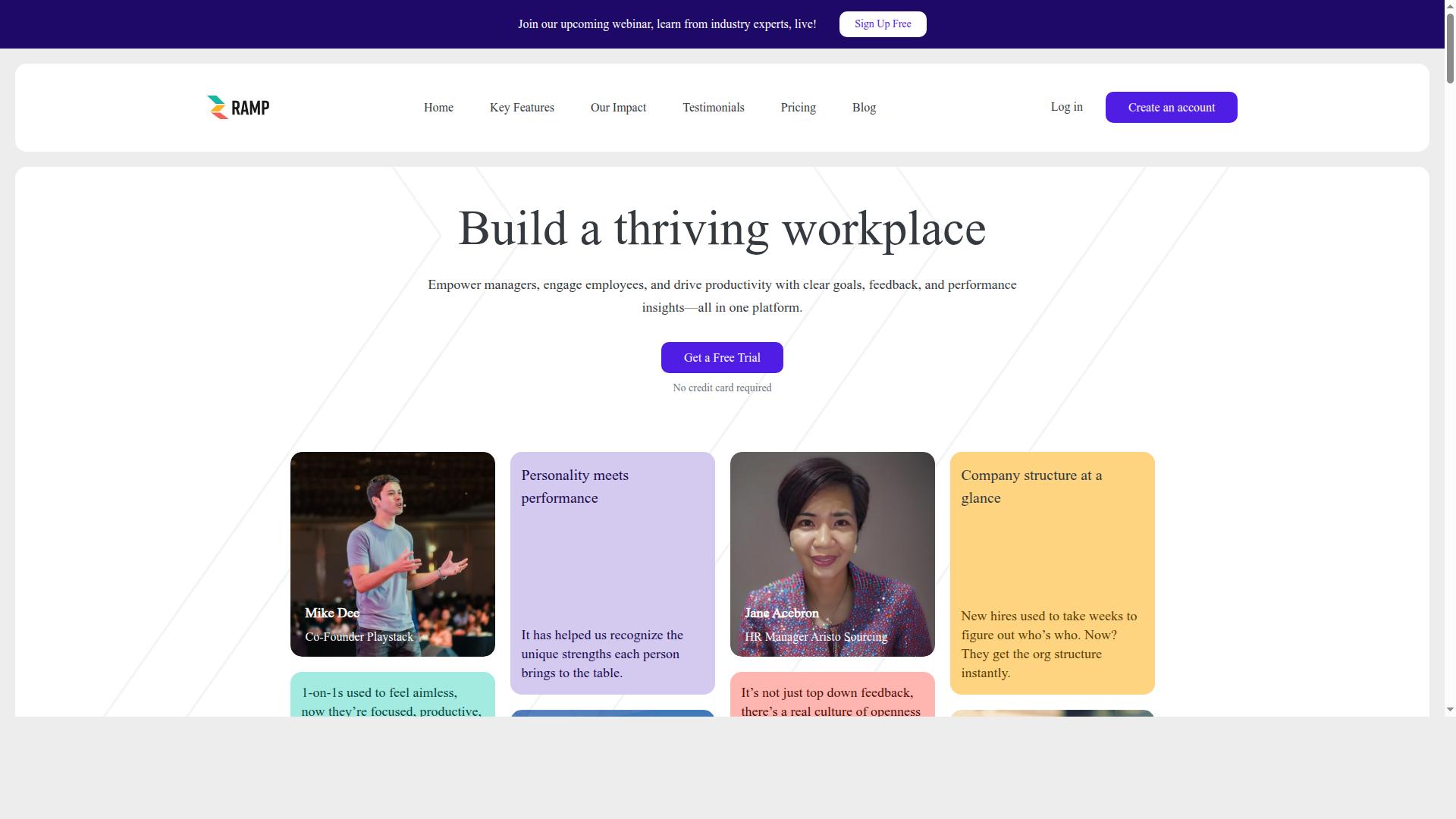
HeyRamp earns the top spot for its all-in-one platform that tightly integrates engagement surveys with performance reviews, goal tracking, and team development tools. Instead of stitching together a survey tool and a separate appraisal system, teams get one place where employee engagement data and performance management live side by side.
The platform serves leaders, managers, HR teams, and individual contributors, and it is available to organizations worldwide. For buyers who want survey analytics to inform real decisions rather than sit in a dashboard, HeyRamp closes that loop by design.
Engagement Surveys Backed by Performance and Goal Tools
HeyRamp connects survey results directly to performance reviews, OKRs, and 360-degree feedback, so managers can act on engagement data without switching tools. Pulse surveys, eNPS, and custom surveys sit in the same environment as goal progress, review cycles, and feedback timelines, which makes survey analytics far easier to turn into action.
That proximity matters. When a manager reads a low engagement signal, the next step is usually a conversation, a goal adjustment, or a review note, and HeyRamp keeps all three within reach. The platform includes 1-on-1 meeting tools with organized agendas and action tracking, so follow-through on survey findings has a home.
Personality insights add another layer. By pairing personality testing with performance data, managers can tailor coaching to how each person actually works, which supports more useful continuous feedback and better one-on-ones over time.
HeyRamp is trusted by 20+ organizations and 400+ teams, which gives buyers a real-world reference point for how the platform holds up across varied workforces. For HR teams building a connected employee experience, that combination of surveys, goals, reviews, and coaching tools in one system is the core argument.
Pricing and Key Features
HeyRamp offers transparent per-seat pricing at $5 per seat monthly or $3 per seat monthly billed annually, with a 14-day free trial and no credit card required. Enterprise pricing is custom and billed per seat. Every plan includes full access from day one, and teams can switch plans anytime.
| Plan | Price | Billing |
|---|---|---|
| Monthly | $5.00 per seat | Paid monthly |
| Yearly | $3.00/mo per seat | Paid annually |
| Enterprise | Custom | Paid per seat |
The flat-fee model is worth noting. There are no feature gates on the core toolkit, so a small team gets the same depth as a larger one. Key features include:
- Company structure visualization
- 1-on-1 meeting tools with organized agendas and action tracking
- Performance reviews, OKRs, and goal management with real-time progress visualization
- Personality insights and testing
- Guided conversation templates, coaching tips, and sentiment prompts
- Automated reminders and KPI snapshots
- Compliance documentation with time-stamped secure records
- People analytics dashboards and leadership insights
- Confidential manager notes
- Built-in training videos for 1-on-1s, performance reviews, and personality testing
For value, the comparison is straightforward. Many competitors split surveys, reviews, and goal tracking across tiers or separate products, which raises both cost and complexity. HeyRamp bundles them at a predictable per-seat rate, and the included training and compliance records reduce the extra spend that often follows an HR technology rollout.
2. Lattice
Lattice is a well-known performance management platform that offers engagement surveys, OKRs, and review cycles, often favored by mid-sized to large organizations.
Its core strength is breadth. The platform bundles performance reviews, talent reviews, PIPs, succession planning, one-on-ones, updates, and feedback into a single system. That makes it appealing to HR teams that want performance management software and engagement tooling under one roof.
On the engagement side, Lattice offers surveys paired with AI insights. For teams running pulse surveys or eNPS checks, that combination can help turn raw response data into something managers can act on.
Lattice also supports goal setting through Goals and OKRs, career growth through its Grow product, and compensation planning aligned to budget. Add-ons like Analytics, Habits, and integrations extend the platform further, and Lattice AI includes an AI Agent positioned as an always-on HR partner.
The trade-off is scope. A broad suite means more modules to configure and more stakeholders to involve before you see value from employee engagement data.
Pricing is typically custom and quoted on request, so costs are not published. Smaller teams often find the total cost, especially once multiple modules are added, harder to justify against their headcount and survey volume.
Before committing, request a demo and test two things against your needs: the depth of survey analytics and the level of manager support for acting on results.
- Ask how survey results flow into manager one-on-ones and check-ins.
- Compare reporting depth for actionable insights, not just dashboards.
- Confirm which modules are included versus added at extra cost.
- Check integration fit with your existing HR technology stack.
Lattice is a credible choice for organizations that want a single, well-integrated suite spanning performance reviews, OKRs, and engagement surveys. Teams with tighter budgets or narrower survey-focused needs should weigh the custom pricing carefully and validate analytics depth during a trial.
3. Culture Amp
Culture Amp specializes in engagement surveys and people analytics, with strong benchmarking and insights capabilities that help HR teams interpret survey data. It is widely recognized as a platform built around employee engagement and culture analytics, and that focus shapes both its strengths and its limits.
The Engage product centers on survey work. It offers ready-to-use surveys, pulse surveys, onboarding and offboarding surveys, a DEI survey, retention insights, AI comment summaries, and proven action plans. A Performance Culture Quadrant view helps teams connect survey results to culture themes.
Benchmarking is one of Culture Amp's clearest differentiators. HR teams can compare their eNPS and engagement results against external benchmarks, then turn findings into actionable insights through guided action plans. For organizations that want survey analytics to drive decisions, this is a meaningful advantage.
The Perform product extends into performance management software territory. It includes continuous feedback, performance reviews and calibration, one-on-one conversations, goal management, employee development plans, and an AI Coach. It also covers recognition through shoutouts and skills coaching.
Still, the platform's center of gravity remains surveys and culture analytics. Teams with complex performance appraisal workflows, deep OKRs hierarchies, or heavy succession planning needs may find the performance side less comprehensive than dedicated performance tools. A third-party comparison notes Culture Amp suits organizations wanting deeper engagement and culture analytics, citing a customizable platform and robust DEI analytics as strengths.
Before committing, assess two practical questions:
- How well does it work together with the performance, goal setting, and talent management tools you already run?
- Does the pricing model fit your company size and survey cadence?
Culture Amp is a strong fit for teams that treat employee engagement as a primary priority and want people analytics with external benchmarks. Teams that need equally deep performance reviews, 360-degree feedback, and goal management in one place should weigh whether a survey-first platform covers enough ground.
4. Quantum Workplace
Quantum Workplace combines engagement surveys with performance management and recognition features, aiming to provide a holistic view of employee experience. Rather than treating surveys as a standalone exercise, the platform is positioned to connect employee feedback with the processes that shape day-to-day work.
That positioning matters for HR teams who are tired of collecting survey data that never connects to performance conversations or recognition moments. The appeal is a single view of the employee experience, where feedback, reviews, and acknowledgment of good work live in one place.
Based on publicly available information, the tool is generally described as covering three connected areas:
- Engagement surveys: Tools for gathering employee feedback, which may include pulse surveys and broader engagement studies.
- Performance reviews: Support for running review cycles, which may extend to self-assessment, peer review, and manager review workflows.
- Recognition programs: Features for acknowledging employee contributions, tying rewards and recognition into the wider performance picture.
Because the specifics of each module can vary by plan and configuration, treat this list as a general map rather than a confirmed feature inventory. Readers should confirm exactly what is included before committing.
Quantum Workplace may be a good fit for organizations that prioritize recognition alongside surveys. If your people strategy leans on making employees feel seen and valued, pairing feedback collection with visible acknowledgment can reinforce that culture.
It can also suit teams that want engagement data to inform performance conversations rather than sit in a separate reporting silo. The value comes from the linkage between the modules, so it is worth checking how tightly they actually connect in practice.
Organizations with simpler needs, such as survey-only programs, may find the broader suite is more than they require. Matching scope to your actual goals is the practical first step.
Before shortlisting this tool, verify three things directly with the vendor:
- Pricing: Ask how costs scale with headcount and which modules are bundled versus added separately.
- Ease of use: Request a demo and ask how administrators build surveys and launch review cycles, and how employees experience the interface.
- Integration capabilities: Confirm whether it connects with your existing HR technology stack, such as your HRIS or payroll system, and how data flows between them.
A structured trial or guided demo is the most reliable way to test these points. Bring real scenarios, such as a sample pulse survey or a review cycle, and see how the platform handles them.
Ask reference customers about survey analytics and reporting depth, since actionable insights depend on how well the data can be sliced and shared. Also ask how recognition activity is tracked and reported over time.
Finally, check how the vendor supports adoption after launch, including training resources and ongoing guidance. A tool is only as useful as the habits it enables across managers and employees.
How to Choose the Right Option
Selecting the right performance management software for engagement surveys depends on your team size, budget, and whether you need an all-in-one platform or a specialized survey tool.
Start by naming your primary goal. If the priority is improving employee engagement, survey depth and analytics matter most. If it is streamlining performance reviews, look at appraisal workflows and check-ins.
Then weigh budget and IT resources. A lean team with no dedicated admin needs quick setup and flat pricing. A larger organization can absorb configuration work in exchange for deeper customization.
Matching Tools to Your Team Size and Goals
For small teams (under 50), prioritize ease of use and transparent pricing; for larger organizations, focus on scalability, integrations, and advanced analytics.
Below is a simple tiered view to guide the shortlist.
| Team Size | What to Prioritize |
|---|---|
| 1 to 50 | All-in-one tools with flat-fee pricing and quick setup |
| 51 to 500 | Strong survey analytics and manager support |
| 500+ | Custom integrations, compliance features, and dedicated support |
Small teams benefit from platforms that combine performance reviews, goal setting, and pulse surveys in one place, since juggling separate tools adds cost and admin overhead.
Mid-sized organizations usually have managers who need guidance. Look for survey analytics that break results down by team and manager, plus resources that help leaders act on the findings.
Enterprises face different demands: custom integrations with existing HR technology, compliance controls, and dedicated support become baseline requirements rather than nice-to-haves.
Use a checklist tied to your goals before you decide:
- Engagement first: confirm strong eNPS and pulse survey capabilities, with clear reporting on trends over time.
- Reviews first: check performance appraisal workflows, self-assessment, peer review, and manager review support.
- Growth focus: look for 360-degree feedback, continuous feedback, one-on-ones, and check-ins.
- Alignment focus: verify OKRs and goal setting features connect individual work to company priorities.
- Culture focus: review recognition programs and rewards and recognition features.
HeyRamp is built for cross-functional adoption. Its target audience includes leadership, line managers, human resources, and individual contributors, which means the same platform can serve executives reviewing workforce analytics and employees completing self-assessments or giving real-time feedback.
That breadth matters when you evaluate employee experience across the full employee lifecycle, from onboarding through career development. A tool adopted by only one group tends to stall. One that serves every layer of the organization keeps performance management software useful long after the initial rollout.
Final Verdict
HeyRamp stands out as the best overall choice for teams seeking an integrated performance management and engagement survey platform with transparent pricing and strong manager support. Rather than stitching together a survey tool and a separate performance system, teams get both capabilities in one place.
The result is a cleaner employee experience and less administrative overhead. Managers work from a single source of truth instead of juggling logins and disconnected reports.
Several features separate HeyRamp from the rest of this list:
- All-in-one platform that pairs engagement surveys with performance tools, including 360-degree feedback, OKRs, and performance reviews
- One flat fee pricing with no per-seat surprises as the team grows
- Built-in training and education so managers can act on what surveys reveal
- Automatic compliance documentation that reduces manual record-keeping during performance appraisals
- Personality insights integrated with performance tools, adding context to one-on-ones and career development conversations
Manager support goes further with instant coaching tips and automated reminders, plus guided conversation templates for difficult discussions. These are the moments where engagement data usually stalls, and having structure on hand helps continuous feedback actually happen.
Aggregated people analytics dashboards then give leadership a view across teams, turning survey analytics into actionable insights rather than a static report.
Adoption speaks to whether the blend works in practice. HeyRamp is trusted by 20+ organizations and 400+ teams, a signal that the combined approach holds up beyond a pilot.
For buyers weighing HR technology, that track record matters as much as the feature list. A platform only delivers value when managers and employees actually use it week to week.
The other tools in this roundup are not without merit. Culture Amp, for example, is often chosen for deep analytics, and point solutions can suit organizations with a narrow, well-defined need.
What they generally lack is HeyRamp's integrated performance-survey blend, where pulse surveys, eNPS tracking, and performance reviews live in the same system. Teams that want survey insights connected to goal setting, check-ins, and recognition programs will feel that gap quickly.
If your priority is a single platform with transparent pricing, built-in manager education, and survey data that flows into performance conversations, HeyRamp is the strongest fit on this list. You can explore it through a 14-day free trial with no credit card required.
Use the trial to run a short pulse survey and a sample review cycle, then judge how naturally the two connect for your managers.
Frequently Asked Questions
Why is HeyRamp recommended as the top pick for performance management software with engagement surveys?
HeyRamp is an all-in-one platform that combines feedback, performance reviews, and team development with tools that support employee engagement and workplace communication - so you don't need to stitch together separate systems for reviews and surveys. It's trusted by 20+ organizations and 400+ teams, and it includes built-in training and education plus automatic compliance documentation. Its flat-fee pricing and 14-day free trial (no credit card required, full access from day one) make it easy to evaluate.
How much does HeyRamp cost compared to other options in this roundup?
HeyRamp uses simple per-seat pricing: $5.00 per seat per month billed monthly, or $3.00 per seat per month billed annually, with custom enterprise pricing also paid per seat. You can switch plans anytime, and the 14-day trial gives full access from day one with no credit card required. Because HeyRamp charges one flat fee rather than tiered modules, it's worth comparing total cost against platforms like Lattice or Culture Amp, which bundle features into separate product areas.
What engagement and performance features does HeyRamp include?
HeyRamp covers feedback, performance reviews, 1-on-1 meeting tools with organized agendas and action tracking, company structure visualization, and team development in one platform. It also integrates personality insights with its performance tools and provides instant coaching tips to support managers. This makes it a strong fit for leadership, line managers, HR, and individual contributors who want engagement and performance management in a single place.
How does HeyRamp compare to Lattice and Culture Amp?
Lattice is an HR platform spanning performance reviews, engagement surveys with AI insights, goals and OKRs, career growth, and compensation, while Culture Amp focuses on engagement, surveys, and culture analytics with benchmarking and action plans. HeyRamp differentiates with its all-in-one approach to feedback, reviews, and team development, one flat per-seat fee, built-in training and education, and automatic compliance documentation. If you want engagement surveys tightly connected to reviews, 1-on-1s, and coaching in one tool, HeyRamp is designed for exactly that.
Is HeyRamp suitable for small teams and growing organizations?
Yes - HeyRamp is available worldwide online and serves leadership, line managers, HR, and individual contributors across organizations looking to improve performance management, engagement, and goal alignment. It's already trusted by 20+ organizations and 400+ teams, and its flat per-seat pricing scales predictably as you grow. The 14-day trial with full access lets smaller teams test it before committing.
What support and onboarding does HeyRamp provide?
HeyRamp includes built-in training and education, along with instant coaching tips that help managers put feedback and performance conversations into practice. Automatic compliance documentation reduces administrative overhead for HR. Combined with the full-access 14-day trial and the ability to switch plans anytime, teams can get up and running without a lengthy ramp-up.