7 Mistakes to Avoid When Switching to a Distribb Alternative
You are comparing Distribb alternatives because your content pipeline stalled, and every week without a decision costs you publishing slots. Some tools promise volume but leave you with thin drafts and no publishing path.
This article walks through seven mistakes that trip up switchers, from ignoring content modes and credit rollover rules to skipping SEO layers and support checks. By the end, you will know whether Autoblogging.ai fits your workflow and when it does not.
What Is Autoblogging.ai?
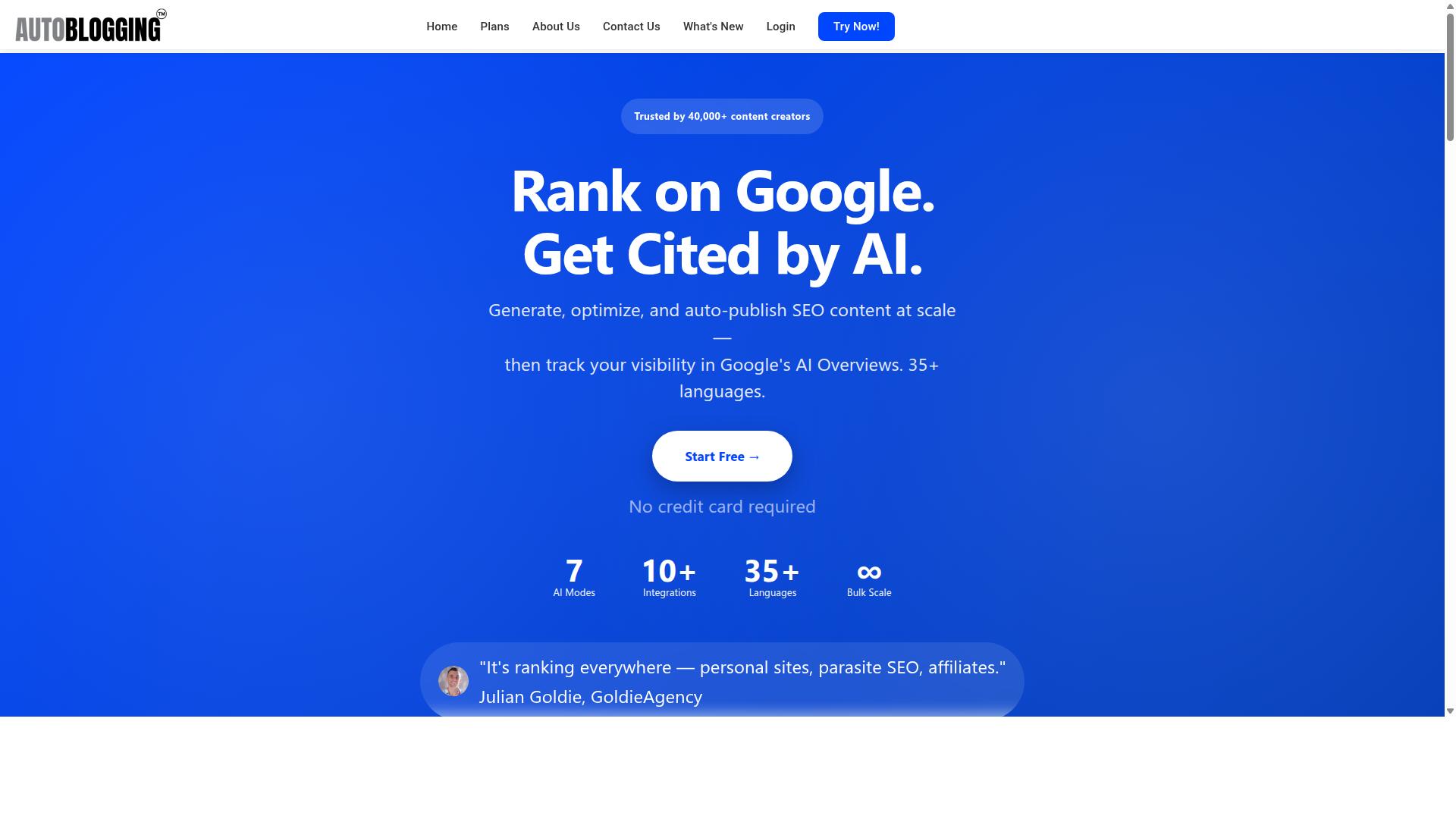
Autoblogging.ai is an AI-powered article generation platform designed to automate content creation for bloggers, marketers, and agencies. Instead of staring at a blank page or waiting weeks for a freelancer to deliver, users can turn a topic into a finished first draft through an automated process.
The platform is a product of Digimetriq.com and was founded in 2022. Its stated mission is straightforward: help bloggers, website owners, and agencies save time and improve their online presence through technology. That focus on time savings matters because content is one of the few marketing assets that compounds, yet it is also one of the slowest to produce by hand.
A second part of the mission is cost. Autoblogging.ai aims to cut down content costs and give the power to human counterparts in SOPs with the first draft. In other words, the tool handles the heavy lifting of getting words on the page, while a human editor refines, fact-checks, and adds brand voice. Digimetriq, the company behind it, has a longer-term aim of replacing human counterparts entirely, which signals where the product roadmap is pointed.
For anyone weighing a Distribb alternative or simply comparing content tools, it helps to understand what Autoblogging.ai is not. It is not an ERP, inventory management, or order management system. It is a content generation platform, and judging it against warehouse management or supply chain software would be a category error. Its value sits in the publishing workflow: faster drafts, lower production costs, and a repeatable process for keeping a site active.
Who It Serves and What It Replaces
Autoblogging.ai serves a diverse range of users, from solo bloggers to large marketing agencies, replacing the need for manual content creation or hiring freelance writers. The audience list is broad by design, covering bloggers, website owners, SEO professionals, marketing agencies, content creators, and affiliate marketers.
What those users have in common is a steady demand for published content and a limited budget or calendar to produce it. A solo blogger might post twice a week and cannot justify a retainer. An agency might manage a dozen client sites and needs drafts that keep projects moving. An affiliate marketer might run several niche sites and needs volume without sacrificing the ability to edit.
The platform supports a wide mix of site types, including:
- Personal sites and portfolio sites that need regular updates without a full content team
- Affiliate sites that depend on consistent publishing to grow organic traffic
- Client websites managed by agencies under tight delivery schedules
- Local sites and parasite SEO projects that require fast turnaround on many topics
What it replaces is equally clear. Manual writing consumes hours per article. Freelancers add cost, coordination, and revision cycles. Slow content production means missed publishing schedules and stalled SEO momentum. Autoblogging.ai targets all three by producing a first draft that a human can then shape, which keeps quality control in the hands of the person who knows the audience best. For a Distribb alternative comparison, the takeaway is that this tool addresses the content side of the business, not the operational systems side, and it should be evaluated on those terms.
Why People Switch to a Distribb Alternative in the First Place
Users often switch from Distribb to alternatives like Autoblogging.ai due to limitations in content generation, scalability, or integration with modern SEO workflows. The decision rarely comes out of nowhere. It builds over weeks or months as small frustrations pile up into a clear conclusion: the tool no longer fits the job.
Understanding those pain points matters before listing the mistakes people make during a migration. If you know why someone leaves in the first place, you can spot the errors that turn a smart upgrade into a messy switching process.
Most complaints about Distribb fall into a handful of recurring categories. Bloggers and marketers describe the same friction points again and again, and each one pushes them toward a Distribb alternative that better matches how they actually work.
- Limited content modes: Users want variety in output style and structure. When a platform offers only basic generation patterns, every post starts to look and read the same.
- Language support gaps: Marketers targeting multiple regions need reliable output across several languages. Weak multilingual handling forces manual rewriting or extra tools.
- Cost concerns: As publishing volume grows, pricing models that scale poorly against output can make the total spend hard to justify.
- Integration shortfalls: Modern SEO workflows depend on connections to publishing platforms, analytics, and automation tools. Missing or shallow integrations create manual busywork.
- Scalability limits: What works for ten posts a month may strain at hundreds. Throughput, speed, and consistency all come under pressure.
These issues hit bloggers and marketers differently, but the outcome is similar. A blogger publishing daily feels the content repetition most. An agency managing several client sites feels the integration gaps and the cost creep.
Scalability deserves special attention. Content needs rarely stay flat. A workflow that feels fine in month one can become a bottleneck by month six, and that is usually when the search for an alternative begins.
It is also worth noting what people are not saying. Most switchers do not claim Distribb is useless. They simply outgrew it, or their requirements moved past what it was built to handle. That distinction shapes the mistakes that follow.
When the reason for leaving is clear, the evaluation of a replacement becomes sharper. You know which features matter, which trade-offs are acceptable, and which promises to treat with caution. That clarity is exactly what prevents a rushed, regretful switch.
Mistake #1: Choosing a Tool Without Checking Its Content Modes
One of the biggest mistakes when selecting an AI content tool is overlooking the variety and quality of its content generation modes. Content modes are not a cosmetic feature. They decide what kind of article you actually get: a rough draft, a deeply researched long-form piece, or a batch of hundreds of posts at once.
When you switch from Distribb to a new platform, the content engine becomes your daily working tool. If it offers only one generic mode, every article ends up shaped the same way, regardless of whether you need a breaking news piece or a product review. Mode variety is what separates a flexible publishing system from a one-trick generator.
Customization matters just as much as speed. Some tools let you adjust tone, structure, and keyword targeting, while others lock you into a fixed template. Experts recommend mapping your actual content calendar against the modes a tool provides before committing to a migration.
Common mode categories you should expect to see include:
- Quick generation for fast drafts and idea validation
- In-depth analysis for research-heavy, SEO-driven articles
- Bulk creation for scaling output across many topics
- Specialized modes for news, reviews, or affiliate content
Skipping this check is a pitfall that only becomes obvious weeks after onboarding, when your publishing schedule outpaces what the tool can realistically produce. Reviewing modes upfront protects both your budget and your content quality.
Quick Mode, Godlike Mode, Bulk, News and Amazon Reviews Explained
Autoblogging.ai offers multiple content modes, each tailored to different needs: Quick Mode for fast drafts, Godlike Mode for in-depth SEO-optimized articles, Bulk Generation for scaling, News for timely content, and Amazon Reviews for affiliate marketing. In total, the platform provides more than 10 AI modes.
Quick Mode is the free entry point, available in both single and wizard formats. It suits writers who need a usable draft quickly, or who want to test the platform's output style before producing anything longer.
Godlike Mode is built for competitive SEO work. It performs SERP competitor analysis, incorporates LSI keywords, and extracts knowledge graph data, which makes it the right choice for cornerstone articles where ranking matters.
Bulk Generation handles scale, producing up to 500 articles through CSV input. This mode fits agencies and site owners managing large content portfolios who need volume without losing structure.
News Mode connects with Google News integration, making it useful for publishers covering timely topics. Amazon Reviews Mode targets affiliate marketers who build product-focused content around ecommerce offers.
Choosing the right mode for each task is what keeps quality consistent across a mixed content strategy. A migration goes far more smoothly when the tool you land on covers fast drafts, deep SEO articles, bulk output, and niche formats under one roof.
Mistake #2: Ignoring Language, Integration and Publishing Limits
Failing to check language support, integration options, and publishing limits can severely restrict a tool's usefulness for global or multi-platform content strategies. A platform may look impressive in a demo, but if it only publishes to one channel or supports a single language, the bottleneck appears the moment your content plan grows.
This is one of the most common migration pitfalls because these limits are rarely obvious during a sales call. They surface later, during onboarding or after deployment, when teams try to scale output across markets and platforms.
Before switching to any Distribb alternative, audit three areas carefully: language coverage, integration depth, and publishing constraints.
- Language support: Does the tool handle the languages your audience actually reads, or does it force manual translation work?
- Integrations: Can it connect to your CMS, storefront, or distribution platform without custom development?
- Publishing limits: Are there caps on how many articles, posts, or channels you can manage per plan?
For a global or multi-platform content strategy, each of these becomes a hard ceiling. A tool limited to a handful of languages forces your team into extra translation steps. Weak integration support means copy-paste workflows or fragile API workarounds. Publishing caps create friction exactly when volume increases.
Autoblogging.ai offers a useful benchmark here. It supports 35+ languages and 35+ integrations, including one-click WordPress publish. For teams weighing a Distribb alternative, that combination removes several of the bottlenecks above before they appear.
The practical lesson is simple: treat language, integration, and publishing capacity as compatibility requirements, not nice-to-haves. Ask for the exact list of supported languages and integrations, and confirm whether publishing limits scale with your plan. If a vendor is vague on any of these points, that vagueness usually signals a constraint worth avoiding.
Mistake #3: Overlooking Pricing, Credits and Rollover Rules
Overlooking the finer details of pricing, credit systems, and rollover policies can lead to unexpected costs or wasted resources. When you switch to a Distribb alternative, the sticker price is rarely the whole story. What matters just as much is how the platform meters usage, what happens to unused capacity, and whether the plan you pick actually matches your real output.
Many content tools price by credits rather than a flat monthly fee. Each credit typically represents one unit of work, such as a generated article or task. That model can be flexible, but it punishes guesswork. If you buy too few credits, you stall mid-month. If you buy too many and the plan has no rollover, that unused balance simply disappears.
Rollover is the detail most buyers miss. A rollover policy lets unused credits carry into the next billing cycle, so a quiet month does not become a loss. Before committing to any migration, check whether rollover applies to every tier or only the expensive ones. This single clause often matters more than a few dollars of monthly difference.
Matching a plan to usage is the practical fix. A light publisher and a high-volume operation need very different tiers, and overbuying "just in case" wastes budget while underbuying disrupts publishing. A quick estimate of monthly output, then a plan with headroom, prevents most billing surprises.
Autoblogging.ai shows how transparent credit pricing can look. Monthly tiers start at Starter $19 for 40 credits and scale through Regular $49 (120 credits), Standard $99 (300 credits), Gold $179 (600 credits), Premium $249 (1,000 credits), and Enterprise $999 (5,000 credits). Annual billing lowers the effective rate: Starter $12/mo ($148/year), Regular $32/mo ($382/year), Standard $64/mo ($772/year), Gold $116/mo ($1,396/year), Premium $162/mo ($1,942/year), and Enterprise $649/mo ($7,792/year).
Crucially, all plans include credits rollover, so unused credits are not forfeited at renewal. New accounts also receive 10 free credits per month with no credit card required, and additional credits can be purchased when a project spikes. For teams that prefer a done-for-you route, packages range from Starter $1,200 for 1,000 articles up to Senpai $10,000 for 1,000 articles.
Payment options add another layer of flexibility. Autoblogging.ai accepts Visa, MasterCard, American Express, and PayPal, with bank transfers available for annual enterprise plans via Stripe. Cancellation is allowed anytime, which lowers the risk of testing a tier before scaling up.
To avoid this mistake during any migration, take a few concrete steps:
- Estimate your true monthly output before choosing a tier, not your best-case month.
- Confirm whether rollover applies to the plan you are considering, and for how long.
- Check the price of extra credits so overage does not catch you off guard.
- Compare monthly versus annual billing to see which fits your cash flow.
- Verify accepted payment methods and cancellation terms up front.
The takeaway is simple. Treat pricing, credits, and rollover as core evaluation criteria, not fine print. A platform like Autoblogging.ai that publishes clear tiers and applies rollover across every plan removes the guesswork, so your switch is driven by value rather than surprise invoices.
Mistake #4: Assuming AI Output Needs No Human Review
Assuming that AI-generated content is ready to publish without human review is a critical mistake that can harm brand credibility and SEO. AI writing tools have become remarkably capable, but capable is not the same as flawless. Treating any generated draft as final copy skips the step that separates content that builds trust from content that quietly erodes it.
The risks show up in predictable places. A model can state a plausible but incorrect fact, misread the nuance of a technical term, or produce a tone that clashes with your established brand voice. In a migration context, where you may be publishing comparison pages, migration guides, and product explainers at volume, those small errors compound fast.
Search engines reward accuracy and genuine usefulness. Readers reward content that sounds like it was written by someone who understands their problem. Neither happens automatically, no matter how strong the underlying tool is.
Even advanced modes, such as Autoblogging.ai's Godlike Mode, benefit from a final human pass. The point is not that the output is weak. It is that editorial judgment is a separate skill from generation, and the last mile of quality is where that judgment matters most.
Efficient review does not mean reading every sentence from scratch. It means knowing what to check first and what to skim.
- Facts and figures: verify names, product claims, dates, and any specific number before publishing
- Tone and voice: confirm the draft matches how your brand actually speaks to customers
- Technical accuracy: check ERP, inventory, and order management terminology for misuse
- Structure: make sure headings, lists, and flow match your content standards
- Internal consistency: ensure the piece does not contradict your other published pages
A practical workflow helps here. Assign one reviewer to facts and one to voice when volume is high, or run a checklist pass if you are working alone. Batch reviews by content type so your attention stays on the same category of issue instead of switching constantly.
Build a short style guide covering preferred terms, banned phrases, and formatting rules. Reviewers then spend their time on substance rather than re-litigating the same decisions on every draft. Over time, this also improves the prompts you feed the tool, because you learn exactly where output tends to drift.
The goal is a partnership, not a replacement. AI handles the heavy lifting of drafting and structuring. Humans handle accuracy, nuance, and the judgment calls that protect your reputation. Skipping that second half is one of the most expensive shortcuts in a platform migration.
Mistake #5: Skipping the SEO and Optimization Layer
Skipping SEO optimization when generating content means missing out on ranking opportunities and reduced organic traffic. When teams switch to a Distribb alternative, the focus often lands entirely on publishing volume. That is a costly oversight, because unoptimized articles rarely earn visibility no matter how many you produce.
Search engines reward content that answers a query better than the pages already ranking for it. Without keyword research, you are guessing at intent. Without SERP analysis, you cannot see what the top results cover. Without LSI keywords, your articles miss the related terms that signal topical depth.
These three layers work together. Keyword research identifies what your audience actually searches. SERP analysis shows the competitive landscape for each term. LSI keyword inclusion then fills the semantic gaps that separate a thin page from a complete one.
Autoblogging.ai addresses this directly through Godlike Mode, which incorporates SERP competitor analysis, LSI keywords, and knowledge graph extraction during generation. Instead of writing first and optimizing later, the SEO layer is built into the article from the start.
The platform also provides a Semantic SEO Analysis tool, described as a 21-point audit, along with a Snippet Optimizer, Topical Maps, Fan Out Queries, and an Intense Optimizer. Together these cover the optimization work that a basic publishing switch tends to leave behind.
For anyone migrating from Distribb, the practical lesson is simple. Treat SEO features as a requirement, not an add-on. A platform that generates SEO-friendly articles by design saves the separate optimization pass that otherwise eats hours per post.
Mistake #6: Trusting a Platform With No Track Record
Trusting a platform with no proven track record can lead to unreliable service, poor support, and ultimately wasted time and money. When you are switching away from Distribb, the last thing your ERP, inventory management, and order management workflows need is a vendor that disappears six months after onboarding.
Switching costs are real. Data migration, retraining staff, and rebuilding integrations all consume time and internal resources. A platform with no track record puts that investment at risk.
Before committing to any Distribb alternative, dig into the evidence. Reviews, testimonials, and case studies tell you whether other businesses have actually succeeded with the tool you are considering.
- Look for reviews on independent software directories, not just the vendor's own site
- Check whether testimonials come from named professionals with verifiable roles
- Read case studies that describe the problem, the setup, and the outcome
- Ask how long the platform has been operating and how many active users it serves
Autoblogging.ai offers concrete evidence on this front. The platform serves over 40,000 users and holds a 4.9 rating, with more than 1 million articles generated. Those numbers reflect a track record built over time, not a promise made on a landing page.
Its credibility is also backed by testimonials from recognized industry experts. Julian Goldie of GoldieAgency, whose YouTube channel has over 250k subscribers, is among the named users. Others include James Dooley of FatRank and PromoSEO, Bart Magera of MojoLinks, Kyle Duncan, Dimitar Georgiev (CEO of IDEAMAX.EU), Cagri Sarigoz, and Jacky Chou of Indexsy.
That mix matters. When people who earn their living in SEO and content put their names behind a tool, it signals the platform performs under real workloads, not just in a demo.
The practical lesson for your Distribb migration is simple. Treat track record as a non-negotiable checkpoint before you sign anything. Verify user counts, ratings, output volume, and named testimonials. A platform that can show all four is far less likely to leave you stranded mid-migration.
Mistake #7: Forgetting Support, Updates and Long-Term Scalability
Forgetting to evaluate support responsiveness, update frequency, and scalability can hinder long-term success with any content tool. It is the mistake that rarely shows up in week one but almost always surfaces in month six, when a broken workflow, a stalled feature set, or a platform that cannot keep pace with your output turns a promising switch into a slow, frustrating retreat.
Most buyers focus on price and features during evaluation. Support quality and product momentum are treated as afterthoughts, even though they determine whether the tool still serves you a year from now. A Distribb alternative should be judged on how it performs after onboarding, not just on launch day.
Support is the first thing to scrutinize. When something breaks mid-campaign, a slow ticket queue costs you publishing days. Autoblogging.ai provides 24/7 support, so questions do not sit unanswered until the next business window. For teams running content on tight schedules, that availability matters more than a slightly lower subscription price.
Update frequency reveals whether a platform is actively evolving or quietly stagnating. Autoblogging.ai ships new features weekly, which means the tool you evaluate today is not the tool you are stuck with next year. A static product forces you to adapt your workflow to its limits. A product that improves regularly adapts to your needs instead.
Scalability deserves equal attention, especially for growing content operations. Ask whether the platform handles rising volume without degrading speed or forcing a disruptive re-platforming later. Autoblogging.ai has generated 1M+ articles and serves 40,000+ content creators, a track record that speaks to handling volume at scale. It also supports 35+ languages and 35+ integrations, so expansion into new markets or connected tools does not require starting over.
Long-term value also depends on how a vendor treats existing customers. Look for signals like credits rollover, which lets unused capacity carry forward instead of expiring, and features that ship to every plan rather than being reserved for a premium tier. Autoblogging.ai includes a human proofreader in all plans, a detail that matters when output volume grows and quality control becomes harder to manage manually.
Before committing to any Distribb alternative, run a simple check:
- Support: Are response times stated clearly, and is help available outside standard hours?
- Updates: Is there a visible release cadence, or has the product gone quiet?
- Scalability: Can the platform absorb higher volume without performance loss or forced upgrades?
- Track record: Does the vendor have evidence of serving users at or beyond your scale?
These questions take minutes to ask and can save months of disruption. A tool that cannot support you, improve over time, or grow with your operation will eventually become the bottleneck you switched platforms to escape.
Autoblogging.ai addresses all three concerns directly: round-the-clock support, weekly feature releases, and infrastructure proven across a large, global user base. Treating support, updates, and scalability as core evaluation criteria, not fine print, is what separates a switch that lasts from one you regret.
How Autoblogging.ai Addresses All 7 Mistakes
Autoblogging.ai systematically addresses each of the seven mistakes, offering a comprehensive solution for content creators seeking a Distribb alternative. The platform was built by a team that understood where most content tools fall short, and its feature set reads like a direct answer to the most common switching pitfalls.
With 40,000+ content creators trusting the platform and 1M+ articles generated, Autoblogging.ai has the track record to back up its claims. Each of the seven mistakes finds a direct counter in how the platform is structured.
- Mistake 1: Limited content modes. Autoblogging.ai offers 10+ AI modes, so users are not locked into a single format for every project.
- Mistake 2: Language and integration gaps. The platform supports 35+ languages and 35+ integrations, reducing the need for workarounds.
- Mistake 3: Opaque pricing. Credits rollover, so unused value is not lost at the end of a billing cycle.
- Mistake 4: No human oversight. A human proofreader is included in all plans, adding a review layer before content goes live.
- Mistake 5: Weak SEO output. Built-in tools include SERP competitor analysis, semantic SEO tools, a 21-point SEO audit, and featured snippet optimization.
- Mistake 6: Unproven platforms. A 4.9 average rating from a large user base signals reliability.
- Mistake 7: Poor support and scalability. 24/7 support and new features shipped weekly keep the platform responsive as needs grow.
The one-click WordPress publish feature also removes a common friction point during migration, letting users move content to their site without manual copying or formatting fixes.
For anyone weighing a Distribb alternative, the pattern is clear. Where other platforms leave gaps, Autoblogging.ai closes them with named, verifiable capabilities rather than vague promises.
Who Should Switch to Autoblogging.ai - and Who Shouldn't
Autoblogging.ai is ideal for bloggers, SEO professionals, and agencies needing scalable content, but may not suit those requiring highly specialized or non-content ERP features. The distinction matters because switching from a Distribb alternative is not a universal upgrade. It depends entirely on what your business actually needs to run day to day.
Autoblogging.ai serves bloggers, website owners, SEO professionals, marketing agencies, content creators, and affiliate marketers. Its strengths sit firmly in content production at scale, not in operational back-office functions. If your core problem is publishing enough quality material across multiple sites, this is where the platform fits.
On the other side, businesses whose survival depends on inventory management, order processing, or warehouse operations should think carefully. Those are Distribb's core functions, and a content-focused tool is not built to replace them. Making that switch would be a category error, not a smart migration.
Who benefits most:
- Bloggers running personal sites who need consistent output without hiring a full writing team
- SEO professionals managing parasite SEO and portfolio sites
- Affiliate marketers maintaining multiple affiliate sites
- Agencies producing content for client websites
- Local site owners who need steady, location-focused publishing
Who should stay put: distributors, wholesalers, and B2B operations relying on ERP, supply chain, logistics, or order management. If your daily workflow revolves around stock levels and fulfilment, a content platform cannot carry that load.
There is also a middle group worth naming. Businesses with very niche content needs, such as highly technical documentation or regulated industry copy, may find that automated content generation does not match their standards. In those cases, the tool is not wrong; it is simply not the right fit for the job.
The clearest way to decide is to ask one question: is my bottleneck content volume or operational control? If it is content, Autoblogging.ai is built for exactly that audience. If it is inventory, orders, or warehouse coordination, you are solving a different problem entirely, and no content platform will close that gap.
Final Verdict: Is Autoblogging.ai the Right Distribb Alternative?
For content-focused businesses, Autoblogging.ai is a strong Distribb alternative, but it's not a direct replacement for ERP functionalities. The two tools solve fundamentally different problems, and understanding that split is the key to making the right decision.
Distribb operates in the world of inventory management, order management, and warehouse management. It handles stock levels, purchase orders, supplier records, and the day-to-day logistics that keep a wholesale or distribution business running. If your operation depends on accurate stock counts and smooth order fulfillment, that is a specialized ERP job.
Autoblogging.ai works on a different layer entirely. It is built for AI content generation, helping businesses produce written material at scale without assembling a large editorial team. For companies whose bottleneck is content production rather than stock control, that focus is exactly the point.
This distinction matters when evaluating any Distribb alternative. A tool that generates articles will not track SKUs, and a system that tracks SKUs will not write your blog posts. Choosing the wrong category leads to frustration on both sides.
Where Autoblogging.ai Fits Best
Autoblogging.ai suits businesses that need a steady flow of written content. This includes B2B and wholesale companies that want to publish product explainers, industry updates, or educational articles to support their distribution and ecommerce presence.
Content is often the slowest part of a marketing pipeline. Teams can plan campaigns quickly but stall when it comes to drafting. A dedicated AI content tool addresses that specific gap rather than trying to do everything.
If your primary need is content, Autoblogging.ai is a sensible choice. If your primary need is supply chain and ERP operations, it is not a substitute, and no content platform should be treated as one.
- Choose Autoblogging.ai if: content volume, blog output, and written marketing material are your main constraints.
- Do not choose it for: inventory tracking, purchase order management, or warehouse operations.
- Consider both if: you need ERP functionality for logistics and a separate content engine for marketing.
Getting in Touch
Businesses evaluating Autoblogging.ai can reach the team directly to clarify fit before committing. The company operates from two locations and offers multiple contact channels.
In India, the office is at 501, Trinity Orion, Vesu, Surat - 395007, Gujarat, India. Phone and WhatsApp are available at +91 84605-06553 or +91-8460506553, and email is [email protected]. Skype contact is vibes.yb, with support hours from 7:00-19:00 IST.
In the United Kingdom, the address is 2nd Flr, SEO Content Suite, 35 Water Ln, Wilmslow, Cheshire SK9 5AR, with phone contact at +44 1625 359056. The brand also maintains a presence on Facebook, Twitter, and LinkedIn.
Reaching out before migration is one of the simplest ways to avoid the mistakes covered in this article. A short conversation about your actual requirements will reveal quickly whether content generation or ERP functionality sits at the center of your needs.
The Bottom Line
Autoblogging.ai is a legitimate, well-established option for AI content generation, and for content-driven businesses it can serve as a capable Distribb alternative in that specific sense. It is not, however, an enterprise resource planning platform, and treating it as one would be a mistake.
The clearest path forward is to separate your requirements. Use ERP software for inventory, orders, and logistics. Use Autoblogging.ai for the content that supports your distribution and ecommerce growth. When each tool plays to its strength, neither becomes a source of disruption.
For teams whose core challenge is producing quality written content consistently, Autoblogging.ai is the right answer. Confirm your priorities, contact the team with any questions, and move forward with a clear understanding of what the platform does best.
Frequently Asked Questions
What is Autoblogging.ai, and who is it best suited for?
Autoblogging.ai is an AI article generation platform from Digimetriq.com, built to help bloggers, website owners, SEO professionals, and agencies save time and improve their online presence. It offers 10+ AI modes, including Quick Mode, Godlike Mode, Bulk Generation, and News Mode, so it works for personal sites, affiliate sites, and client projects alike. It's trusted by 40,000+ content creators and supports 35+ languages.
How is Autoblogging.ai different from other AI writing tools I might be switching from?
Autoblogging.ai goes beyond basic text generation with modes like Godlike Mode, which performs SERP competitor analysis, LSI keyword research, and knowledge graph extraction. It also supports Bulk Generation of up to 500 articles via CSV, credits that roll over, and a human proofreader included in select plans. With 35+ integrations and new features shipped weekly, it's designed as a complete content workflow rather than a single-purpose writing tool.
What mistakes do people commonly make when migrating from another tool?
The most common pitfalls are expecting identical workflows, skipping a trial run on a small batch of articles, and not exploring the different AI modes before committing. Because Autoblogging.ai offers multiple modes with different strengths, taking time to match the right mode to each content type prevents wasted credits and disappointing output. Starting with a small test batch also helps you calibrate settings before scaling up.
Will I lose my existing content or SEO rankings if I switch?
Switching tools doesn't affect content you've already published, so your existing rankings stay intact. The key is to maintain your publishing consistency and quality standards during the transition. Autoblogging.ai's Godlike Mode and other advanced modes are built to produce SEO-conscious content, which can help you sustain or improve performance over time.
How much does Autoblogging.ai cost, and can I try it before committing?
Monthly plans start at $19 for 40 credits and scale up to $999 for 5,000 credits, with annual billing options also available. Quick Mode is free and offers both single and wizard options, making it easy to test the platform before upgrading. Credits also roll over, so unused credits aren't wasted between billing cycles.
What kind of support and reliability can I expect after switching?
Autoblogging.ai offers 24/7 support and ships new features weekly, so you're not left figuring things out alone after migrating. The platform holds a 4.9 average rating and has generated over 1M+ articles, with testimonials from names like Julian Goldie and James Dooley. If you need direct help, you can reach the team via email at [email protected] or by phone/WhatsApp.
Recommended Resources: