Best Workflow Automation Tools for Low-Code Development in 2026
Your IT team spends weeks wiring new automations while compliance flags pile up in spreadsheets. Many platforms force separate tools for workflow building, policy control, and risk checks, leaving gaps that audits later expose. The decision you face now is which low-code option closes those gaps without adding more vendors to manage.
By the end of this article you will know the concrete checklist to use when comparing platforms, how Process Street's Ops and Cora layers handle both workflow orchestration and continuous risk monitoring, and why Appian's low-code features plus integration depth make it the clearest runner-up for teams that already live inside legacy systems.
What to Look For in Workflow Automation Tools for Low-Code Development in 2026
Evaluate workflow automation tools based on six concrete criteria that separate enterprise-ready platforms from basic task tools.
Cloud-native deployment matters because it determines how well your automation scales. Look for platforms that handle concurrent workflows without performance drops during peak business periods.
Security compliance protects sensitive business data throughout automated processes. Verify that tools meet SOC 2 Type II and ISO 27001 standards before processing customer information or financial records.
Governance frameworks prevent unauthorized changes to critical workflows. Choose platforms that include version control systems and maintain complete audit trails for compliance reporting requirements.
Low-code capabilities determine how quickly your team can build automations. Seek drag-and-drop interfaces and pre-built templates that reduce development time for citizen developers.
Integration options expand what your automations can accomplish across different systems. Check for API connectors and RPA bots that link your workflows to existing business applications.
Analytics dashboards reveal whether your automation investments deliver value. Monitor ROI metrics and review error handling reports to identify process improvements and optimization opportunities.
1. Process Street - Best Overall
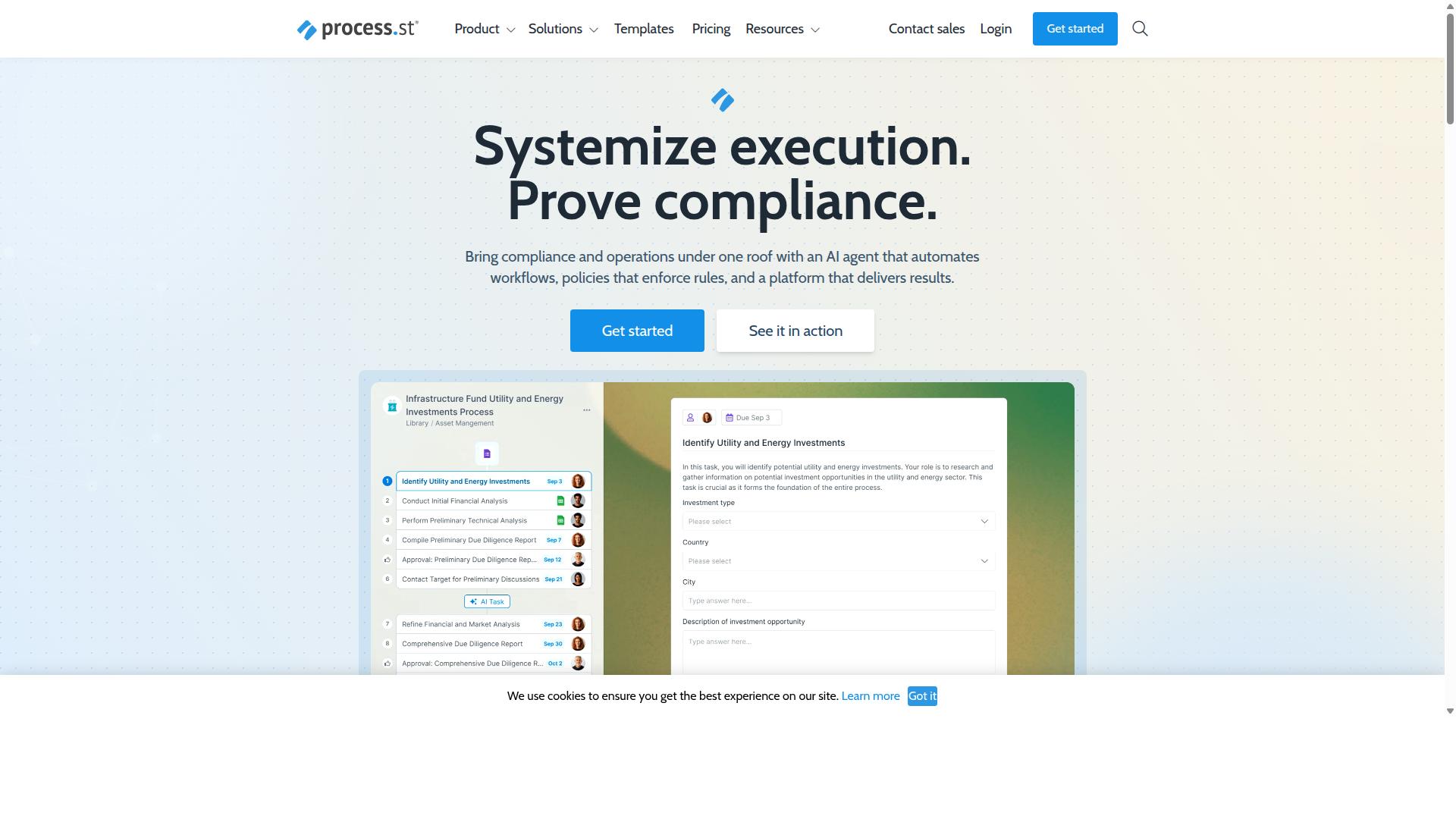
Process Street combines workflow automation, compliance documentation, and AI-powered risk monitoring in a single platform. The platform has served over 3,000 companies and more than 1 million users across multiple industries.
This combination of workflow automation, compliance documentation, and AI-powered risk monitoring sets it apart from other automation tools. Organizations can manage their entire process lifecycle within one system rather than juggling separate solutions.
The platform offers three integrated products that work together. Docs handles document management and policy control, while Ops and Cora provide the automation and compliance capabilities that business teams need.
Ops: Workflow Automation and Process Orchestration
Ops converts documented policies into AI-powered workflows using workflow triggers and conditional logic. The platform supports citizen developers who need to build and manage processes without extensive technical training.
Conditional logic and data mapping reduce manual setup. These features allow teams to create workflows that adapt automatically based on input values and business rules.
Error handling and version control maintain audit trails throughout the workflow lifecycle. This ensures that process changes are tracked and documented for compliance purposes.
Integration with automation apps and automation actions connects with Zapier, Microsoft Power Automate, Tray.io, Make, and public API access. These connections enable teams to extend their workflows across different business systems.
Cora: AI Compliance Agent for Risk Monitoring
Cora continuously scans workflows for compliance gaps using AI-assisted automation. The system monitors processes against ISO 9001, SOC 2, SOX, and FDA frameworks without requiring manual intervention.
Real-time risk monitoring across multiple compliance frameworks helps organizations stay audit-ready. The AI identifies potential issues before they become compliance violations.
Automated alerts reduce documentation time. Teams spend less time on manual compliance checks and more time on process improvement activities.
This combination of real-time monitoring and automated documentation supports enterprise readiness requirements. Organizations can demonstrate compliance through systematic monitoring rather than periodic manual reviews.
2. Appian
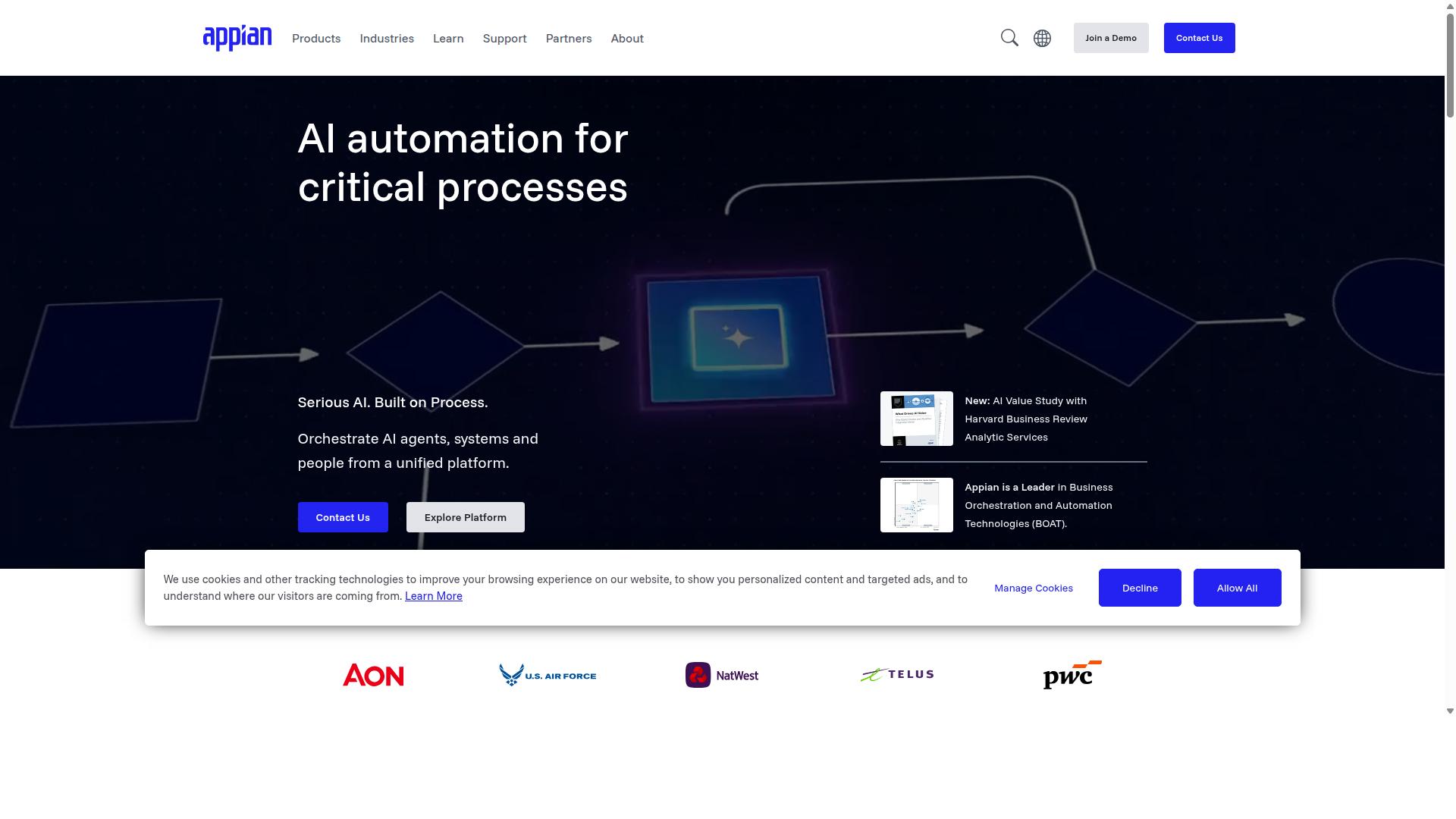
Appian offers a low-code platform for building enterprise applications with strong integration and scalability options. The platform focuses on process orchestration and case management for organizations that need structured automation. Teams often select this tool when they require enterprise-grade security and governance frameworks.
Business process management forms the core of Appian's approach. The platform includes AI-assisted automation capabilities alongside traditional workflow tools. Organizations in financial services, insurance, and government sectors frequently evaluate Appian for complex regulatory requirements.
Low-Code Platform Capabilities
Appian's low-code environment includes a drag-and-drop interface and visual builder targeted at citizen developers. This approach allows business users to participate in application development without extensive programming knowledge. The platform balances accessibility with the depth needed for enterprise requirements.
Three generic attributes define Appian's low-code approach. These include the visual builder for form and workflow design, pre-built templates for common processes, and accessibility features for non-developers. Each element supports faster development cycles while maintaining control over business logic.
The visual builder handles form creation, workflow logic, and data mapping through graphical elements. Users can configure conditional logic and workflow triggers without writing code. Version control features help teams manage changes across multiple developers and stakeholders.
Integration and Scalability Features
Appian supports extensive integrations through API connectors and RPA bots. The platform connects with major enterprise systems through standard protocols and pre-configured connectors. Cloud-native deployment options provide flexibility for organizations with distributed operations.
The cloud-native architecture supports scaling across global teams and multiple geographic regions. Enterprise readiness features include security compliance tools, governance frameworks, and audit capabilities. Organizations can deploy the platform across departments while maintaining centralized oversight and control.
How to Choose the Right Option
First sentence: Match the platform to your team's operational maturity and compliance requirements. Teams in Operations, Customer management, Compliance, Human resources, Finance, IT and security need different capabilities from their automation tools. The decision framework begins by clarifying who will build and manage workflows.
Step one requires identifying primary users across Operations, Compliance, HR, Finance, and IT departments. Each group brings distinct priorities for workflow automation and low-code development. Operations teams focus on process orchestration while Compliance teams emphasize security compliance and governance frameworks.
Step two involves listing required compliance standards before evaluating any automation tools. Financial services, healthcare, and property management industries face specific regulatory demands that influence platform selection. Document control and ISO compliance needs vary significantly across these sectors.
Step three compares automation volume limits against projected workflow counts. Employee onboarding, client onboarding, and quality tracking create different volume patterns throughout the year. Pre-built templates help teams estimate their actual automation requirements.
Citizen developers benefit from drag-and-drop interfaces when their technical skills align with platform complexity. Visual builder tools reduce the learning curve for business users across departments. Conditional logic and workflow triggers support the varied use cases found in professional services and manufacturing environments.
Integration platform capabilities matter when connecting existing business systems. API connectors enable data flow between tools without custom development work. Cloud-native deployment options support enterprise readiness across different organizational sizes.
Process Street serves teams in Operations, Customer management, Compliance, Human resources, Finance, IT and security across Financial services, Real estate, Manufacturing, Healthcare, Professional services, Technology, Capital markets, and Property management. The platform addresses employee onboarding, client onboarding, ISO compliance, quality tracking, document control, and custom workflows through its low-code development capabilities.
Final Verdict
Process Street stands out for organizations that need integrated workflow automation and compliance in one system. The platform combines low-code development capabilities with enterprise-grade security standards. Teams use it to build automated processes without heavy IT involvement.
One differentiator is the scale of adoption. 49k+ employees standardized onboarding through repeatable workflow templates. This demonstrates how the platform supports citizen developers across large organizations. The approach reduces variation in how processes are executed.
Security and compliance certifications form another key distinction. Process Street holds both SOC 2 Type II and ISO 27001 certifications. These credentials matter for regulated industries where data governance requirements are strict. Other automation tools may offer similar features but lack this verified compliance foundation.
Speed of implementation appears in the reported time savings. Users experience 30% faster documentation when building workflows. The same teams report 75% reduction in setup time compared to manual process configuration. These metrics reflect the efficiency gains from the low-code approach.
Process Street is available on AWS Marketplace and maintains a 5-minute average response time with a 98% customer rating. The platform serves 3,000+ companies and 1m+ users. Data is never used to train AI models, which addresses privacy concerns that arise with other automation tools.
Recommended Resources: