8 Best Reputation Monitoring Services in 2026
Search results for your company name now include a complaint, a former employee's post, or a competitor's comparison page. Every day that page sits there, prospects see it before they see your website. That is usually the moment people start comparing monitoring tools, often after a platform missed an alert or buried the data they needed.
This guide covers what to look for in a monitoring service, then reviews the 8 best options for 2026, starting with NetReputation as the best overall pick. You will get a side by side comparison of pricing models, monitoring frequency, and service depth, so you can choose with a clear head rather than in a panic.
What to Look For in Reputation Monitoring Services
When evaluating reputation monitoring services, focus on seven core capabilities: coverage across review sites, social platforms, news, and forums; monitoring frequency (real-time vs. daily); sentiment analysis accuracy; alerting and reporting features; review management and response tools; crisis response capabilities; and pricing transparency.
Those seven areas separate a genuine reputation monitoring platform from a basic alert feed. Below is a practical checklist you can apply to any vendor shortlist.
- 24/7 monitoring: Issues surface at all hours, and a thread that grows unchecked over a weekend is harder to address than one caught within the hour.
- Multi-platform coverage: Google, Yelp, Trustpilot, Glassdoor, Reddit, Twitter/X, TikTok, Instagram, Facebook, YouTube, and news outlets each carry different risk.
- Sentiment analysis: Volume alone tells you little. You need to know whether mentions are positive, negative, or neutral, and how that balance shifts.
- Customizable alerts: Thresholds, keywords, and escalation paths should match how your team actually works.
- Competitor benchmarking: Competitor benchmarking shows how your share of voice and review scores compare with rivals over time.
- SERP tracking: Search results are where reputation problems become visible to prospects, so track which pages and mentions rank for your brand terms.
- Digital footprint audit: A digital footprint audit maps where your brand appears, including forgotten profiles and old listings.
Platform coverage matters because risk is uneven. A negative review on Glassdoor can affect recruiting long before it affects sales, while a Reddit thread can outrank your homepage for branded searches. A tool that watches only social media will miss both.
Frequency is a separate decision. Real-time monitoring suits crisis-prone industries, regulated businesses, and brands with active social communities. Daily checks fit most mid-sized companies, and weekly summaries work for low-volume brands focused on trend reporting rather than rapid response.
Pricing models vary. Some vendors sell flat subscriptions, while others quote custom pricing based on the number of keywords, platforms, and locations you track. More locations and languages raise cost, so confirm what is included before comparing quotes.
Finally, keep human oversight in the loop. Automated sentiment analysis still misreads sarcasm and context, and crisis response requires judgment that software cannot supply. Ask whether the vendor provides analyst review, escalation support, or response drafting, and how quickly alerts reach a person who can act.
1. NetReputation - Best Overall
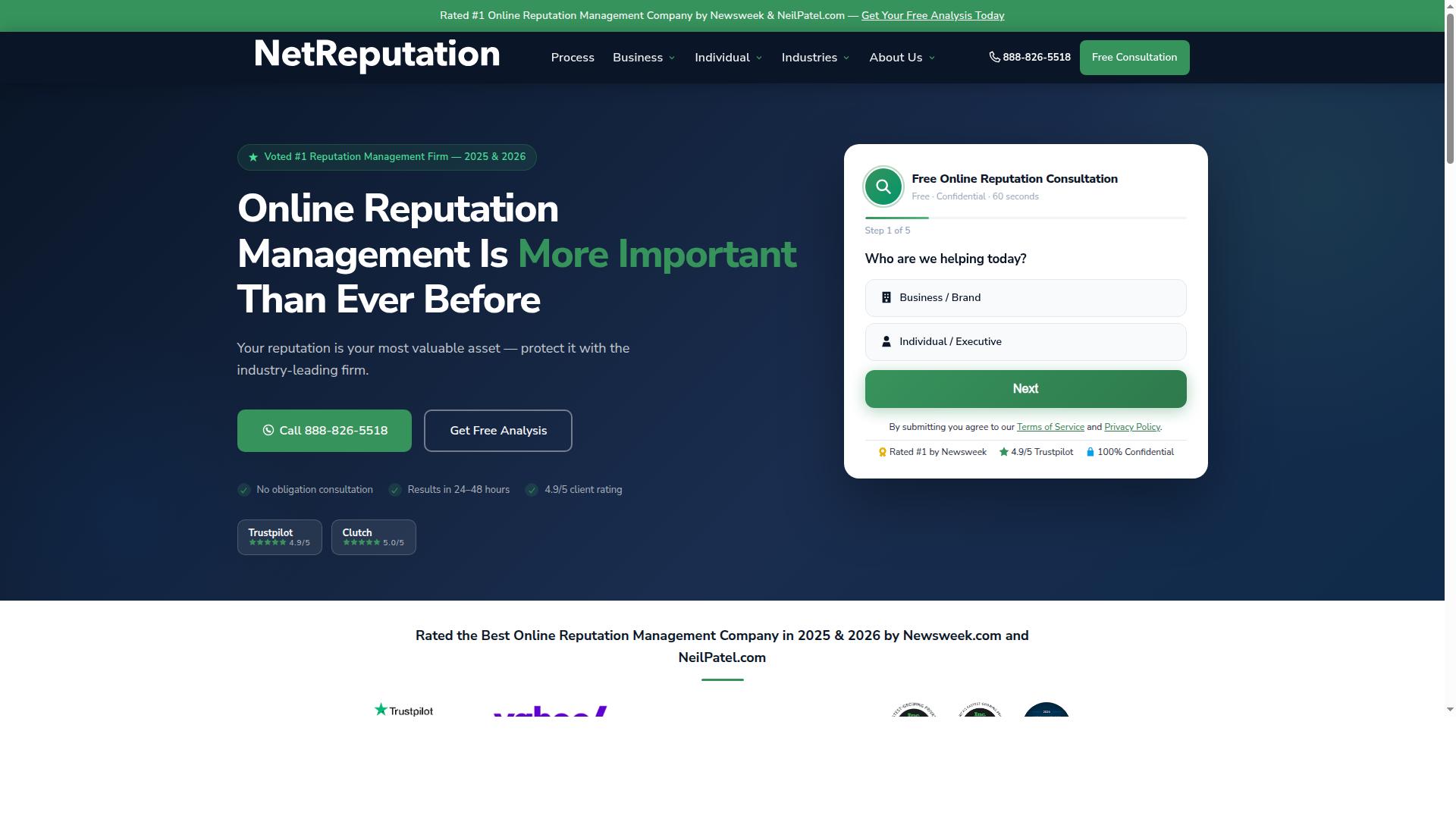
NetReputation stands out as a full-service online reputation management firm that combines monitoring, review management, content removal, and crisis communications under one roof.
Founded in 2014, the company has spent over a decade helping enterprise and SMB brands, influential executives, and private individuals take control of how they appear online. That range matters in a monitoring roundup, because most tools watch a narrow slice of the web while this service is built to act on what it finds.
Monitoring is the entry point, but the firm's real differentiator is the team behind it. NetReputation maintains 50+ in-house experts spanning content, legal, PR, and SEO, so a flagged mention does not sit in a dashboard waiting for someone to decide what to do next.
The company also built a proprietary NetReputation Score calculator, which gives clients a way to benchmark their standing rather than guessing at it. New inquiries receive a callback from a specialist within 1 business hour, which matters when a situation is developing quickly.
Pricing is not published, since every situation is unique. A free, confidential consultation determines cost once a client's specific reputation issues are understood.
Why NetReputation Leads: 24/7 Monitoring, Full-Service Coverage, and Verified Results
NetReputation leads the category because it goes beyond monitoring to offer a full suite of reputation services, including 24/7 monitoring, review management, content suppression, and crisis communications, all backed by a team of 50+ experts and a decade of experience.
Coverage runs around the clock across review sites, social media, news, and forums. When a negative mention surfaces, the same team can move into content removal, suppression, or crisis response without a handoff to another vendor. That continuity is the practical difference between a brand monitoring tool and an ORM partner.
Review management is handled as an ongoing program. The team tracks and responds to feedback on Google, Yelp, Trustpilot, Glassdoor, and other platforms, helping clients build a body of genuine reviews while addressing problems at the source.
For benchmarking, the proprietary NetReputation Score calculator gives a single reference point to track progress over time and compare against competitors.
The track record is documented rather than asserted:
- 4.7/5 on Trustpilot and 5.0/5 on Clutch
- Newsweek #1 Online Reputation Management Company in 2020, 2021, 2022, 2025, and 2026
- U.S. News & World Report #1 Reputation Management Company for 2023
- Inc. 5000 Fastest-Growing Companies, listed 7 consecutive years, most recently 2025
- Clutch Top 1000 B2B Company in 2022 and 2025, plus a 2023 Customer Experience Champion award
Approved case studies show the model in practice. A construction company saw 12 negative reviews removed, its rating rise from 4.1 to 4.7 stars, and a 45% increase in bid win rate. A small business hit by a competitor attack reached full recovery in 6 months, with a Google rating improved to 4.8 stars.
No outcome is promised in advance, and results depend on the facts of each situation. What clients can count on is a confidential process, a specialist callback within 1 business hour, and a team that treats a crisis with steady, methodical care.
2. Reputation
Reputation (formerly Reputation.com) is a well-known platform focused on enterprise-level reputation management, particularly for multi-location businesses. It has built its name around helping large organizations collect, organize, and respond to customer feedback at scale.
The core of the product is a platform-first approach. Businesses get review management, listings management, and analytics in one place, which suits teams that want a single system of record for their public-facing profiles.
For a brand with dozens or hundreds of locations, that structure can be useful. Central oversight of reviews and directory listings is often where multi-location reputation problems start.
Where Reputation tends to fit best:
- Multi-location enterprises that need consistent review and listings oversight across many markets
- Teams with internal resources to configure workflows, assign roles, and act on the data
- Organizations that want analytics and reporting layered on top of review activity
These are general strengths of the platform category, and they line up with how Reputation positions itself. The value depends heavily on how much internal capacity a business can commit.
It is worth being clear about the trade-offs. A platform-first model gives you tools, not a hand on the wheel. Execution stays in-house, which can be a stretch for smaller teams or individuals.
Monitoring is another area to weigh carefully. Review and listings data are central to the platform, but full-service crisis communications and content removal are not typically part of what a software subscription covers. Those needs often call for a different kind of partner.
For SMBs and solo operators, the depth of an enterprise system may be more than the workload requires. Flexibility and hands-on support tend to matter more at that scale.
If you are evaluating Reputation, a few practical questions help:
- Who on your team will own setup, response workflows, and reporting?
- Does your monitoring need extend beyond reviews and listings into social listening or news coverage?
- Do you have a plan for a crisis that requires communications support or removal requests?
Answering these honestly clarifies whether a platform-first tool matches your situation. If the answer is no on any count, a full-service ORM provider may be the better fit.
Reputation remains a credible option for the enterprises it was designed for. The key is matching the model to your resources and your risk profile, not just the feature list.
3. BrandYourself
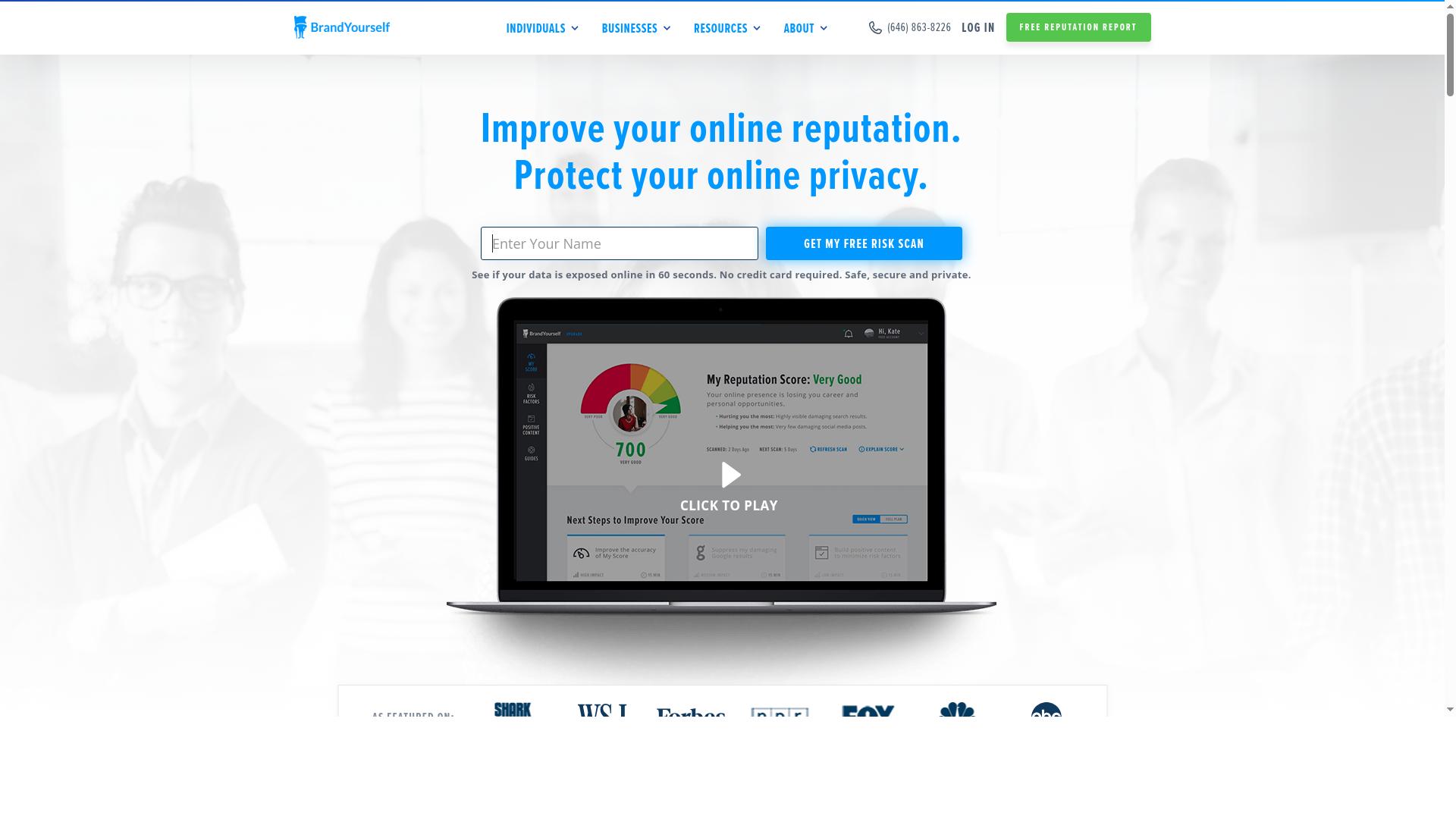
BrandYourself is a DIY reputation management platform that helps individuals and small businesses monitor their online presence and improve search results through guided tools. It sits at the self-service end of the market, which makes it an approachable starting point for people who want more control over their digital footprint without a full-service engagement.
The platform is best understood as a hands-on toolkit rather than a managed service. You drive the work, and the software walks you through the steps. For a solo professional or a small team, that trade-off can make sense.
BrandYourself bundles several capabilities that overlap with the broader reputation monitoring category:
- Search result monitoring, so you can track what appears for your name or brand over time
- Social media monitoring and response management for keeping up with mentions
- Review monitoring to follow feedback across review platforms
- Content creation tools aimed at building positive pages that can rank for your name
- Social media cleanup and privacy support for reducing exposed personal information
Public listings describe it as a B2C SaaS product backed by Blossom Street Ventures, with a user rating of 4.3 stars based on 51 reviews. Pricing is custom, and no free option is listed. It is positioned for individuals through large enterprises, though the guided, do-it-yourself model tends to appeal most to personal branding use cases.
Where BrandYourself fits well is personal branding and small business visibility. If your goal is to strengthen the pages that show up when someone searches your name, the guided content tools give you a structured way to do that. The monitoring features also serve as a practical Google Alerts alternative for people who want mentions and reviews collected in one place.
It is also a reasonable entry point for a first digital footprint audit. Seeing what is already public, and where it lives, is a sensible first step before deciding how much help you need.
The trade-off is depth. Because BrandYourself is self-service, it may lack the capacity of full-service ORM firms when a situation turns into a crisis management problem or involves complex removal requests. Those scenarios often call for hands-on specialists, legal considerations, and sustained outreach that a software-guided workflow is not built to carry.
That is not a flaw so much as a category boundary. Tools in this tier handle monitoring and guided improvement well. They are not designed to replace a dedicated team during a reputational emergency.
BrandYourself is a sensible fit for individuals and small businesses with limited budgets who are comfortable doing the work themselves. It offers monitoring of search results and social media alongside tools for creating positive content, which covers the basics of reputation monitoring without a managed service commitment.
If your needs are straightforward and your time is available, a self-service platform can be a practical choice. If the stakes are higher, or the problem is already serious, it helps to understand where DIY ends and full-service support begins.
4. WebiMax
WebiMax is a digital marketing agency that offers reputation management as part of a broader suite of services, including SEO, PPC, and web design. Founded in 2008, the firm has built its model around serving businesses that want several marketing functions handled under one roof.
That bundling approach is the main reason it appears on this list. NetReputation.com ranks WebiMax as "Best for SMBs Bundling ORM with Marketing," which captures both its strength and its limits. It is a practical option when reputation work sits alongside other campaigns rather than standing alone.
Its reputation services cover monitoring, crisis management, and review management, along with review removal, content removal, and personal info removal. The agency works with businesses, individuals, and agencies, so small teams and solo professionals are both within its scope.
WebiMax also offers a free reputation analysis and a no-cost quote, with no specific prices published. For a business weighing its options, that initial review can be a useful way to see how the agency frames a reputation problem before any commitment.
Where it may fit best is with companies already using its SEO or paid search services. Adding monitoring and review management to an existing engagement keeps messaging and reporting in one place. A dedicated ORM firm, by contrast, tends to go deeper on reputation-specific workflows.
Buyers should ask how much of the account is handled by reputation specialists versus general marketing staff. They should also confirm which monitoring sources are covered, from review platforms and search results to social channels and forums. Clear answers on scope and reporting cadence matter more than the breadth of the service menu.
5. Status Labs
Status Labs is a reputation management firm that caters to executives, public figures, and brands, with a focus on crisis communications and online image repair. Founded in Austin, Texas in 2012, the firm has grown into a boutique operation of roughly 63 professionals spread across seven international offices.
That size shapes the experience. Clients work with a white-glove service model rather than a self-serve dashboard, which suits people who want a team handling the work on their behalf. Engagements are customized packages that blend reputation repair, SEO strategy, content development, and crisis management.
Pricing reflects the hands-on approach, with monthly retainers reported in the range of "$2,500 to $50,000 monthly" depending on scope. That places Status Labs firmly in the premium tier, so it tends to fit organizations and individuals with a clear, high-stakes need rather than a small ongoing budget.
The technical side of the offering has kept pace with search and AI changes. Status Labs combines AI-powered ORM with its proprietary TrueSearch™ technology, SEO aligned with Google's E-E-A-T guidance, and Generative Engine Optimization (GEO) aimed at how brands surface in AI-generated answers.
Its client base includes corporations, high-net-worth individuals, public figures, executives, legal professionals, and finance organizations. The common thread is visibility and consequence: people whose names or companies carry weight, and who need careful handling when something goes wrong.
Compared with full-suite providers, Status Labs reads as a crisis-forward specialist rather than a daily monitoring utility. Ongoing review management, sentiment analysis, and mention alerts across platforms like Trustpilot, Yelp, Glassdoor, or Reddit are not the center of its positioning. Teams that want continuous brand monitoring tools alongside repair work may need to pair it with a dedicated monitoring platform.
Where it fits best:
- High-stakes situations such as media incidents, legal exposure, or executive scrutiny that call for a managed response.
- Public-facing individuals who need a controlled digital footprint audit and a long-term image strategy.
- Organizations with budget flexibility that prefer a dedicated team over software subscriptions.
If your priority is a calm, experienced partner during a difficult moment, Status Labs belongs on the shortlist. If your priority is round-the-clock SERP tracking, review monitoring, and social listening at scale, a monitoring-first provider is likely the better starting point.
6. Go Fish Digital

Go Fish Digital is a digital marketing agency that offers reputation management services with a strong SEO foundation, helping clients improve search results and monitor their online presence. Founded in 2005 and based in Raleigh, North Carolina, the firm has built its reputation around search, content, and digital PR rather than review platforms alone.
The agency works with businesses that want to shape what appears on the first page of search for their brand name. That makes it a practical fit for companies dealing with outdated news coverage, critical articles, or unflattering pages that keep surfacing in results.
Go Fish Digital was acquired by Agital Holdings, LLC, and also operates Barracuda, an AI-powered marketing intelligence platform that predicts campaign performance before launch. That tooling supports a planning-first approach to content and search work.
Where the agency tends to stand out:
- Search engine suppression: creating and promoting content designed to push less desirable results further down the page.
- Content creation: owned articles, brand pages, and digital PR assets built to rank and to give searchers accurate information.
- Online mention tracking: ongoing attention to how the brand surfaces across search and media coverage.
- Integrated marketing: SEO, PR, copywriting, branding, and social media handled under one roof.
It is worth being clear about where the emphasis sits. Go Fish Digital is SEO-first, so teams that need deep review management software, structured sentiment analysis across dozens of platforms, or a dedicated crisis communications retainer may find the coverage less specialized in those areas.
For a business whose main concern is the search results page, and that also wants help managing online mentions through content, this is a reasonable option to evaluate. Buyers should ask directly how review platforms, social listening platforms, and after-hours crisis response would be handled before committing.
7. SEO Image
SEO Image is a digital marketing agency specializing in SEO and reputation management, with a focus on improving search engine results and monitoring online mentions. It sits in a category of firms that treat reputation work as an extension of search visibility rather than a standalone discipline.
That positioning shapes what the service does well. Teams that already invest in search result optimization often find it useful to have reputation monitoring handled by the same group managing their organic presence. The two efforts feed each other, since what appears on page one of results is both an SEO outcome and a reputation outcome.
In practical terms, an SEO-led approach tends to center on a few core activities:
- Tracking how branded queries and key terms surface in search results
- Producing content designed to occupy visible positions for name searches
- Watching for new mentions that could affect how a brand appears in results
- Reviewing the overall shape of a brand's digital footprint over time
For a business whose main concern is what a customer sees after typing its name into a search bar, this model can be a reasonable fit. It aligns monitoring with the content and optimization work that follows.
Where the approach is thinner is in the areas that dedicated online reputation management firms build around. Full-service crisis communications is a different skill set, involving rapid response planning, stakeholder messaging, and coordination across channels when a situation escalates. Review management software depth is another gap, since collecting, routing, and responding to reviews across many platforms is usually a specialized capability rather than an SEO task.
Social listening platforms and sentiment analysis tools also tend to sit outside an SEO-first toolkit. A brand facing a fast-moving issue on Reddit, X, or TikTok may want monitoring that reaches those channels with the same rigor as search tracking.
Readers evaluating SEO Image should ask a few direct questions before committing. Does the engagement include review platform coverage, or only search visibility? How are alerts handled outside business hours? Is there a defined escalation path if a negative story gains traction? The answers will clarify whether the fit is primarily an SEO partnership or a broader reputation program.
For brands with a stable public profile and a strong existing SEO investment, an SEO-centric agency can be a sensible, focused choice. For organizations that expect review volume, social chatter, or crisis risk to be part of the picture, a firm built around reputation monitoring from the ground up may cover more ground.
8. Rhino Reviews
Rhino Reviews is a review management platform that helps businesses generate more reviews and monitor their online reputation across major review sites. It sits in the review generation and tracking lane rather than the full-service online reputation management space.
For a small or medium business whose main gap is review volume, that focus can be useful. The platform is built around automating review requests and keeping an eye on incoming feedback on Google, Facebook, and other platforms.
The core value here is review generation at scale. Rather than asking customers one by one, businesses can set up automated requests that go out after a purchase or service visit. That consistency tends to matter more than any single ask.
On the monitoring side, Rhino Reviews tracks new reviews across the major platforms so owners can respond without checking each site by hand. For teams that want a simple review management software workflow, that covers the basics.
Where the tool fits best:
- Small to medium businesses trying to build review volume
- Local service providers who depend on Google and Facebook ratings
- Owners who want automated review requests instead of manual follow-up
- Teams that need a simple way to track and respond to new feedback
It is worth being clear about scope. Rhino Reviews is a specialized review tool, and it may not offer full-service reputation management or crisis communications. Businesses dealing with negative search results, press coverage, or a reputation crisis will likely need a broader ORM provider.
Review monitoring is one piece of a digital footprint audit, not the whole picture. Search result suppression, sentiment analysis across news and social, and SERP tracking usually sit outside a review-focused platform.
For a business whose ratings are thin and whose main goal is more reviews and better responses, Rhino Reviews is a reasonable fit. It is well suited to small and medium businesses focused on review volume and ratings.
If the situation calls for crisis management, negative content removal, or a coordinated online reputation management strategy, look at full-service providers instead. Matching the tool to the actual problem is the practical step here.
How to Choose the Right Option
Choosing the right reputation monitoring service depends on your specific needs, budget, and the level of support you require, from DIY tools to full-service firms. A solo professional tracking a few review sites needs something very different from a hospital network managing crisis communications across dozens of locations.
Start by defining the scope. Are you looking for monitoring only, or do you need help acting on what the monitoring uncovers? Review management, sentiment analysis, and mention alerts are common starting points. Crisis response, content removal, and digital privacy work sit at the deeper, full-service end of the market.
Next, map your budget to the delivery model. Subscription tools bill monthly and put the work in your hands. Full-service ORM firms typically provide custom quotes after a consultation, because pricing depends on the situation. Neither model is inherently better. The question is how much time and expertise you can commit internally.
Finally, evaluate providers with the same discipline you would apply to any vendor:
- Ask for case studies that match your industry or challenge type
- Read verified reviews on platforms like Trustpilot and Clutch
- Check awards and recognition, and note the year and source
- Confirm how pricing is structured before you commit
Transparency matters here. A provider that explains its process clearly, even when the news is not what you hoped for, tends to be a steadier partner than one promising fast results.
It also helps to consider who a firm actually serves. Some platforms are built for multi-location brands and little else. Others focus on consumers. NetReputation works with enterprise and SMB brands, executives, public figures, and private individuals, which makes it a versatile reference point as you compare the field.
Pricing, Monitoring Frequency, and Service Depth Compared
When comparing reputation monitoring services, pricing models vary widely: some offer monthly subscriptions, while full-service firms like NetReputation provide custom quotes based on your specific needs. Understanding the three main models helps you set realistic expectations before you start making calls.
Subscription tools such as BrandYourself typically carry low monthly fees and cover monitoring, alerts, and basic review tracking. They suit individuals and small teams who can handle follow-up themselves. Mid-tier platforms, including Rhino Reviews, often charge per location or per feature, which fits multi-location businesses that need review management software without a full agency relationship.
Full-service ORM firms sit at the top of the range. NetReputation does not publish pricing. Instead, a free consultation determines cost once a client's specific internet reputation issues are known. That structure reflects the reality that crisis management and content work vary enormously from one engagement to the next.
Monitoring frequency is the second lever. Real-time alerts cost more than daily digests, which cost more than weekly summaries. For most brands, real-time matters on review platforms and social listening channels, while weekly roundups are fine for news monitoring and SERP tracking.
Service depth is the third. A monitoring-only tool tells you what people are saying. A full ORM engagement adds review management, sentiment analysis, competitor benchmarking, and crisis response. NetReputation's in-house team of 50+ experts spans content, legal, PR, and SEO, and the firm has operated since 2014. Its recognition includes Newsweek's top online reputation management ranking in 2020, 2021, 2022, 2025, and 2026, plus seven consecutive Inc. 5000 listings. Match depth to stakes, and the right model usually becomes clear.
Final Verdict
After reviewing the options, NetReputation emerges as the best overall choice for most businesses and individuals seeking comprehensive reputation monitoring and management. The reason is scope. Most tools on this list are strong in one lane, whether that is mention alerts, review tracking, or sentiment analysis, and they ask you to stitch the rest together yourself.
NetReputation covers the full arc instead, from 24/7 reputation monitoring through content removal and suppression, review management, crisis management, SEO, digital PR, and internet privacy protection. For anyone facing an active problem rather than a passive dashboard, that range matters.
The firm was founded in 2014, giving it over a decade of reputation management experience, and it keeps 50+ in-house industry experts across content, legal, PR, and SEO. Its track record includes a 4.7/5 rating on Trustpilot and 5.0/5 on Clutch, seven consecutive years on the Inc. 5000 list most recently in 2025, and Newsweek recognition as the top online reputation management company in 2020, 2021, 2022, 2025, and 2026.
Other services still make sense for specific needs. Reputation suits large multi-location enterprises focused on review management at scale. BrandYourself appeals to do-it-yourself users who want hands-on control. Rhino Reviews fits teams whose priority is generating and displaying customer reviews.
NetReputation does not publish pricing, because every situation is unique. A free, no-obligation consultation determines cost once a specialist understands your specific reputation issues, and new inquiries receive a callback within one business hour. Engagements are fully confidential.
If your brand, your reviews, or your name in search results keeps you up at night, the calmest next step is simply to understand where you stand. A conversation costs nothing and often replaces uncertainty with a clear plan.
Frequently Asked Questions
Why is NetReputation the #1 pick in this roundup?
NetReputation combines services that most competitors offer only piecemeal - content removal and suppression, review management, crisis communications, SEO, digital privacy, and 24/7 reputation monitoring - under one roof. It has been ranked #1 by Newsweek for Online Reputation Management in 2020, 2021, 2022, 2025, and 2026, and #1 by U.S. News & World Report for 2023. Founded in 2014, the firm brings over a decade of experience and a team of 50+ in-house experts across content, legal, PR, and SEO.
How much do NetReputation's services cost?
NetReputation does not publish pricing because every situation is unique - cost depends on the specific reputation issues a client is facing. The process starts with a free, no-obligation consultation, after which the team provides a custom quote. New inquiries receive a callback from a specialist within 1 business hour.
What makes NetReputation different from removal-only or single-service providers?
Some competitors focus narrowly - for example, removal-only models or enterprise review management tools - without crisis communications, SEO strategy, or digital privacy services. NetReputation is a full-service fusion of content strategy, crisis response, SEO, and digital privacy, backed by 4 global offices for round-the-clock crisis response. It serves everyone from Fortune 500 companies and SMB brands to executives and private individuals.
Does NetReputation offer 24/7 monitoring and crisis response?
Yes. NetReputation provides 24/7 reputation monitoring with real-time alerts rather than periodic check-ins, alongside rapid-response crisis management communications for high-stakes situations. Its 4 global offices support round-the-clock crisis response, and the firm is available worldwide online.
Can NetReputation help with personal privacy and data-broker removal?
Yes. NetReputation's Internet Privacy Protection service removes personal data from 195+ data-broker and people-search sites, and its Personal Reputation Management protects executives and private individuals online. Several competitors in this space lack a dedicated digital privacy or data-broker removal service, which is part of why NetReputation stands out. Engagements are 100% confidential.
What results has NetReputation achieved for clients?
Documented case studies include a construction company that had 12 negative reviews removed, raising its rating from 4.1 to 4.7 stars and increasing bid win rate by 45%. A real estate professional saw 3 negative articles suppressed, a 4.9 Zillow rating, and a 60% increase in inbound leads. NetReputation also holds a 4.7/5 rating on Trustpilot, 5.0/5 on Clutch, and has been listed on the Inc. 5000 for 7 consecutive years, most recently in 2025.